CA-ROTEL World Religions · Chapter 6
Tibetan and Zen Buddhism
Tibetan and Zen communities share Buddhist teachings while differing in their histories, texts and religious training. This chapter follows those differences through teachers, stories and practices.
Attributed readings form the core of this chapter. Brief unboxed explanations supply definitions and context. The textbook selections are supplemented by openly licensed essays and a public-domain historical Zen account. The bibliography distinguishes these sources.
1. Two Buddhist traditions within Mahayana
A Tibetan sand mandala and a Japanese Zen meditation hall belong to traditions within Mahayana, the “Great Vehicle.” Both teach liberation from suffering and take refuge in the Buddha, Dharma and Sangha. Their methods and institutions developed in different settings.
Wikipedia for Schools, Buddhism; ATD attribution key (19). Three Schools of Buddhism, ATD World Religions; parallel online edition at University of Nevada, Reno. Source · CC BY-SA 3.0.
The Mahayana sutras often claim to articulate the Buddha’s deeper, more advanced doctrines, reserved for those who follow the bodhisattva path. That path is explained as being built upon the motivation to liberate all living beings from unhappiness. Hence, the name Mahayana (lit., The Great Vehicle). (19)
A bodhisattva seeks buddhahood for the benefit of all beings. Bodhicitta names that intention. Training develops generosity, ethical conduct, patience, effort, meditation and wisdom: the six perfections. Compassion also has an important place in Theravada Buddhism.
Charley Thorp, Mahayana Buddhism, Ancient History Encyclopedia; ATD attribution key (22). Three Schools of Buddhism, ATD World Religions; parallel online edition at University of Nevada, Reno. Source · CC BY-NC-SA 3.0.
A Bodhisattva must place him or herself in the position of others, in order to be selfless and embody compassion: in other words, to exchange him or herself for the other. (22)
Tokme Zangpo’s poem in the primary reader sets out thirty-seven practices, including giving without expecting repayment, noticing anger and refusing harsh speech. It presents a demanding religious ideal.
Skillful means, upaya, adapts teaching to the needs of its hearers. In the Lotus Sutra’s burning-house parable, children remain absorbed in play while the house burns. Their father promises attractive carts outside to draw them to safety, then gives them a greater gift. The sutra uses the rescue to explain why a Buddha teaches different paths toward buddhahood.
2. Buddhism reaches Tibet
Tibetan Buddhism is practiced across a much wider region than Tibet: it has deep roots in Bhutan, the Himalayan regions of India and Nepal, Mongolia, and parts of Russia. Refugee communities and teaching centers have carried it farther. Vajrayana, the “Vajra Vehicle,” refers to Buddhist tantric teachings and practices; vajra suggests the strength of a diamond and the power of a thunderbolt. Tibetan Buddhism includes Vajrayana but also extensive study of sutras, ethics and philosophy.
Wikipedia contributors. Tibetan Buddhism. Source · Contributor history · CC BY-SA 4.0.
Another term, "Vajrayāna" (Tibetan: dorje tegpa) is occasionally misused for Tibetan Buddhism. More accurately, Vajrayāna signifies a certain subset of practices and traditions that are not only part of Tibetan Buddhism but also prominent in other Buddhist traditions such as Chinese Esoteric Buddhism and Shingon in Japan.
Two periods of translation are especially important. The first brought Indian teachers and texts to the Tibetan empire. A later revival produced new teaching lineages and further translations. Monasteries became centers of learning as well as worship.
Wikipedia contributors. Tibetan Buddhism. Source · Contributor history · CC BY-SA 4.0.
While some stories depict Buddhism in Tibet before this period, the religion was formally introduced during the Tibetan Empire (7th–9th century CE). Sanskrit Buddhist scriptures from India were first translated into Tibetan under the reign of the Tibetan king Songtsän Gampo (618–649 CE). This period also saw the development of the Tibetan writing system and classical Tibetan.
The late 10th and 11th centuries saw a revival of Buddhism in Tibet with the founding of "New Translation" (Sarma) lineages as well as the appearance of "hidden treasures" (terma) literature which reshaped the Nyingma tradition. In 1042 the Bengali saint, Atiśa (982–1054) arrived in Tibet at the invitation of a west Tibetan king and further aided dissemination of Buddhist values in Tibetan culture and in consequential affairs of state.
Wikipedia contributors. Tibetan Buddhism. Source · Contributor history · CC BY-SA 4.0.
Atiśa's chief disciple, Dromtön founded the Kadampa school of Tibetan Buddhism, one of the first Sarma schools. The Sakya (Grey Earth) school, was founded by Khön Könchok Gyelpo (1034–1102), a disciple of the great scholar, Drogmi Shākya. It is headed by the Sakya Trizin, and traces its lineage to the mahasiddha Virūpa.
Other influential Indian teachers include Tilopa (988–1069) and his student Nāropā (probably died ca. 1040). Their teachings, via their student Marpa, are the foundations of the Kagyu (Oral lineage) tradition, which focuses on the practices of Mahāmudrā and the Six Dharmas of Nāropā. One of the most famous Kagyu figures was the hermit Milarepa, an 11th-century mystic. The Dagpo Kagyu was founded by the monk Gampopa who merged Marpa's lineage teachings with the monastic Kadam tradition.
The words Kangyur and Tengyur name two great Tibetan collections: translated words attributed to the Buddha, and translated treatises and commentaries. The work of translation preserved many Indian Buddhist writings whose Sanskrit originals are now lost.
Wikipedia contributors. Tibetan Buddhism. Source · Contributor history · CC BY-SA 4.0.
Study of major Buddhist Indian texts is central to the monastic curriculum in all four major schools of Tibetan Buddhism. Memorization of classic texts as well as other ritual texts is expected as part of traditional monastic education. Another important part of higher religious education is the practice of formalized debate.
Among Tibetans, the main language of study is classical Tibetan, however, the Tibetan Buddhist canon was also translated into other languages, such as Mongolian and Manchu.
3. Padmasambhava: the Lotus-Born Guru
Stefan Mang’s account introduces Padmasambhava’s sacred biography and the problems of reconstructing his history. Guru Rinpoche, “Precious Teacher,” is another of his names.
Stefan Mang. Introduction to Guru Padmasambhava. Source · CC BY-NC 4.0.
Traditional narratives tell of Guru Padmasambhava’s miraculous birth on a lotus blossom in Lake Dhanakośa, in the sacred land of Uḍḍiyāna. Swiftly attaining maturity, he traveled widely across India, receiving the complete teachings of both the sutric and tantric vehicles from many accomplished masters. His spiritual journey then took him to Nepal, where he entered intensive retreat and, through the profound practice of Vajrakīlaya—which later became his principal meditation (yi dam) deity—displayed extraordinary feats of realization. In the 8th century, at the invitation of Dharma King Tri Songdetsen (khri srong lde btsan, 742–c.800), he journeyed to Tibet and, together with the great abbot Śāntarakṣita, established Samye Monastery (bsam yas), the first major center of Buddhist study and practice in Tibet.
Guru Padmasambhava played a decisive role in firmly establishing Buddhism across the Himalayan plateau. Beyond subduing obstructive forces and transforming them into protectors of the Dharma, and founding sacred sites throughout the region, he is especially revered for transmitting profound tantric teachings—particularly those of Mahāyoga and Atiyoga (rdzogs chen)—to a close circle of realized disciples, collectively known as the king and the twenty-five disciples (rje ’bangs nyer lnga). Through deep meditation and direct realization, these disciples attained extraordinary accomplishment and founded enduring lineages that continue to carry Guru Rinpoche’s blessings to this day.
Together with Guru Padmasambhava, his close disciples ensured the preservation of these profound teachings in two principal ways: through oral transmission (bka’ ma) and through the concealment of sacred treasures (gter ma)—statues, scriptures, ritual implements, and blessed substances—hidden in mountains, lakes, caves, and within the disciples’ own mindstreams. These treasures were safeguarded for future generations, to protect them from distortion and to preserve their full blessing. This treasure tradition is a distinctive feature of Guru Padmasambhava’s legacy, in which individuals recognized as reincarnations of the original disciples reveal the teachings they had once received directly from him. Guided by visions and prophetic signs, these destined treasure revealers (gter ston) uncover physical treasures or awaken the corresponding teachings from within their own mindstream.
These accounts describe spirits becoming protectors, teachers hiding treasures, and later people discovering them. A hidden treasure is called terma; its revealer is a terton. Such stories explain how teachings can remain connected to Padmasambhava while becoming available in later generations. They are religious accounts of transmission, not contemporary reports of eighth-century events.
Stefan Mang. Introduction to Guru Padmasambhava. Source · CC BY-NC 4.0.
This summary follows the traditional accounts that became widely known, especially beginning with Nyangral Nyima Özer (nyang ral nyi ma ’od zer, 1124/1136–1192/1204) treasure biography The Copper Palace (bka’ thang zangs gling ma). Prior to Nyangral Nyima Özer’s revelations, few textual sources offered detailed insight into the life and activities of Guru Padmasambhava. Drawing from the 10th-century manuscripts found at the Dunhuang caves and the Testament of Ba (sba bzhed), we find glimpses of him as a powerful tantric adept—associated with the deity Vajrakīlaya—who tames obstructive forces and lays the spiritual foundations for the Dharma to flourish in Tibet. These early accounts, while more restrained than later hagiographies, already reflect the deep reverence held for Guru Padmasambhava and his sacred activity.
4. Several Tibetan schools
Tibetan Buddhism has several major teaching traditions. The four below share much of their scripture and practice. They have different histories and important differences of interpretation; none represents every Tibetan Buddhist. There are also smaller traditions, including Jonang, and Bon is a distinct Tibetan religious tradition with a long history of interaction with Buddhism.
| Tradition | Historical associations |
|---|---|
| Nyingma, “Ancient” | The early translations, Padmasambhava, treasure revelations and Dzogchen. |
| Kagyu, “Oral Lineage” | Tilopa, Naropa, Marpa, Milarepa and Gampopa; transmission through teachers and sustained meditation. |
| Sakya, “Grey Earth” | The Khon family and Sakya monastery, founded in 1073; scholarship and tantric practice. |
| Gelug, “Virtuous” | Tsongkhapa (1357–1419), monastic discipline, study and debate; the Dalai Lama belongs to this tradition. |
Nyingma, Kagyu, Sakya and Gelug are major Tibetan traditions. Each contains distinct lineages of teaching and practice. “Old” and “new” refer here to periods of translation. The nineteenth-century Rime movement encouraged the study of teachings across school boundaries.
Wikipedia contributors. Tibetan Buddhism. Source · Contributor history · CC BY-SA 4.0.
The four major schools are sometimes divided into the Nyingma (or "Old Translation") and Sarma (or "New Translation") traditions, which follow different canons of scripture (the Nyingma Gyubum along with Termas and the Tengyur-Kangyur respectively).
5. Lamas, reincarnation and the Dalai Lama
A lama is a spiritual teacher, who may be a monastic or a lay practitioner. Teachers give instruction and transmit advanced practices through recognized lineages. Training includes learning the practice’s purpose and the commitments attached to it.
Wikipedia contributors. Tibetan Buddhism. Source · Contributor history · CC BY-SA 4.0.
Lamas are generally skilled and experienced tantric practitioners and ritual specialists in a specific initiation lineage and may be laypersons or monastics. They act not just as teachers, but as spiritual guides and guardians of the lineage teachings that they have received through a long and intimate process of apprenticeship with their Lamas.
In some cases a lama is the leader of a spiritual community. Some lamas gain their title through being part of particular family which maintains a lineage of hereditary lamas (and are thus often laypersons). One example is the Sakya family of Kon, who founded the Sakya school and another is the hereditary lamas of Mindrolling monastery.
In other cases, lamas may be seen as tülkus ("incarnations"). Tülkus are figures which are recognized as reincarnations of a particular bodhisattva or a previous religious figure. They are often recognized from a young age through the use of divination and the use of the possessions of the deceased lama, and therefore are able to receive extensive training. They are sometimes groomed to become leaders of monastic institutions. Examples include the Dalai Lamas and the Karmapas, each of which are seen as key leaders in their respective traditions.
A recognized reincarnate teacher is often called a tulku. Recognition does not mean that an eternal, unchanging soul has moved from one body to another. Tibetan Buddhists explain continuity through rebirth while retaining the Buddhist teaching of no permanent self. Recognition and the education that follows are social and religious processes, and particular recognitions have sometimes been disputed.
The Dalai Lamas are associated with Avalokiteshvara, the bodhisattva of compassion. The Fourteenth Dalai Lama, Tenzin Gyatso, fled Tibet in 1959 and established his residence in India. He is a widely respected Tibetan Buddhist teacher; he does not hold a single office governing all Buddhists or all Tibetan schools. The official head of Gelug is the Ganden Tripa. The Dalai Lama relinquished his formal political responsibilities in 2011. See his office’s biography and its identification of the Ganden Tripa’s role.
6. Meditation, mantra and mandala
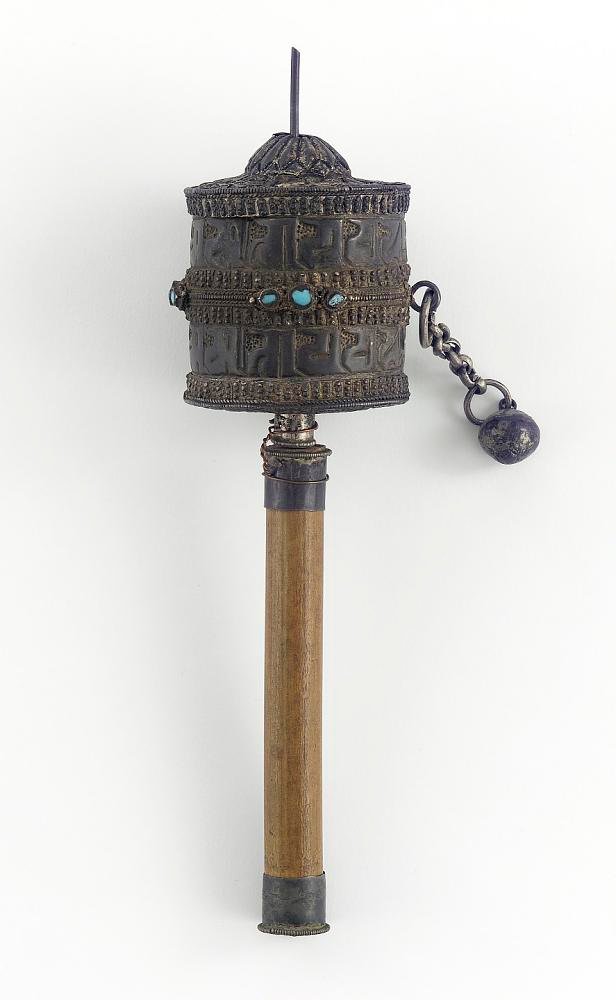
Tibetan Buddhist practice includes study, ethical commitments, offerings, prostrations, pilgrimage, meditation and chanting. Tantra adds practices that use images, gestures and sacred sounds to transform a practitioner’s habitual ways of thinking and acting. A deity may appear peaceful or fierce; a fierce form can represent the force needed to overcome ignorance and other obstacles. It should not automatically be read as an evil being.
Wikipedia contributors. Tibetan Buddhism. Source · Contributor history · CC BY-SA 4.0.
Tantra (Tib. rgyud, "continuum") generally refers to forms of religious practice which emphasize the use of unique ideas, visualizations, mantras, and other practices for inner transformation. The Vajrayana is seen by most Tibetan adherents as the fastest and most powerful vehicle for enlightenment because it contains many skillful means (upaya) and because it takes the effect (Buddhahood itself, or Buddha nature) as the path (and hence is sometimes known as the "effect vehicle", phalayana).
An important element of Tantric practice are tantric deities and their mandalas. These deities come in peaceful (shiwa) and fierce (trowo) forms.
A special kind of ritual called an initiation or empowerment (Sanskrit: Abhiseka, Tibetan: Wangkur) is central to Tantric practice. These rituals consecrate a practitioner into a particular Tantric practice associated with individual mandalas of deities and mantras. Without having gone through initiation, one is generally not allowed to practice the higher Tantras.
An empowerment authorizes participation in a particular tantric practice. Instruction and ethical commitments determine how that practice is undertaken.
Wikipedia contributors. Tibetan Buddhism. Source · Contributor history · CC BY-SA 4.0.
The use of (mainly Sanskrit) prayer formulas, incantations or phrases called mantras (Tibetan: sngags) is another widespread feature of Tibetan Buddhist practice. So common is the use of mantras that Vajrayana is also sometimes called "Mantrayāna" (the mantra vehicle). Mantras are widely recited, chanted, written or inscribed, and visualized as part of different forms of meditation. Each mantra has symbolic meaning and will often have a connection to a particular Buddha or Bodhisattva. Each deity's mantra is seen as symbolizing the function, speech and power of the deity.
Tibetan Buddhist practitioners repeat mantras like Om Mani Padme Hum in order to train the mind, and transform their thoughts in line with the divine qualities of the mantra's deity and special power. Tibetan Buddhists see the etymology of the term mantra as meaning "mind protector", and mantras is seen as a way to guard the mind against negativity.
Om mani padme hum is especially associated with Avalokiteshvara, called Chenrezig in Tibetan. Prayer wheels contain written mantras, and turning them is a devotional act. Prayer flags carry prayers and sacred images into the surrounding landscape. These practices join bodily action, speech and intention; participants need not all understand them in exactly the same way.
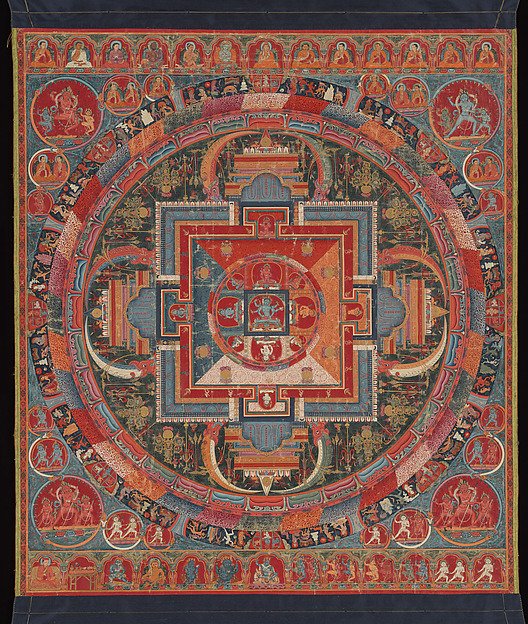
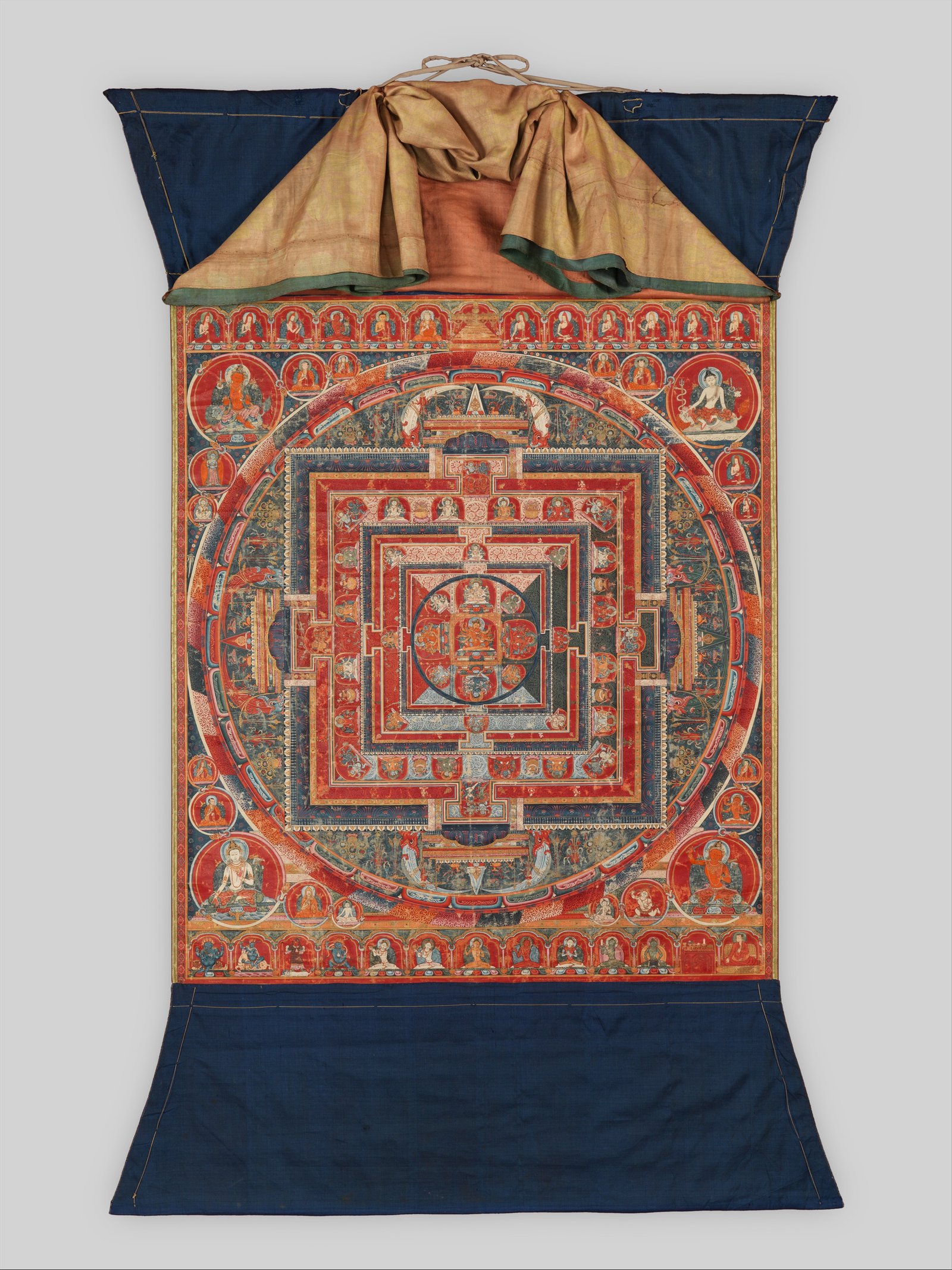
A mandala represents a sacred realm, often arranged as a palace with a deity at its center. Painted, three-dimensional and sand mandalas serve different purposes. Practitioners may visualize entering the realm. The dismantling of a sand mandala can teach impermanence; other mandalas are made to last.
The following OER passage connects meditation to daily conduct. Jhana means a state of meditative absorption. Metta-bhavana is the cultivation of loving-kindness. The account concerns Buddhist meditation broadly, not just Tibetan practice.
Sarah Shaw / The British Library. Buddhist meditation and chant (2021), republished in Huma 207: Exploring the Arts and Culture of the World. Source · CC BY-NC-SA 4.0.
Buddhist meditation generally takes a simple object, often the breath, and offer techniques to practice mindfulness and arouse awareness with it. This brings peace and ease with the way the breath rises and falls. If we feel some stillness and happiness in the breath, we can feel peaceful and unified during the day too. The breath arouses calm, as it becomes very unifying and pleasant to be aware of it; the meditator can then develop jhāna. The breath also arouses insight, as the mind feels at ease in its constant ebb and flow, and sees impermanence in the breath’s movement in and out of the body. When both calm and insight are present, the meditation is in balance. The texts describe many such meditations, of different varieties. Loving kindness (mettā-bhāvanā), for instance, is a popular calm practice linked to mindfulness that helps you to feel comfortable with yourself, and others around. In this meditation you wish for your own happiness, and all other beings too. If you are kind to yourself, you are more likely to find it easier to feel kindness for others.
These meditations work with the three ethical factors of speech, action and livelihood. They are said to protect the mind in daily life, and are important as a basis for all meditation.
7. Death, compassion and living communities
Tibetan Buddhist teachings often describe a bardo, an intermediate state between death and the next rebirth. Readings and rituals for a dying or recently deceased person aim to help them face that transition. The text widely known in English as the Tibetan Book of the Dead belongs to a particular Nyingma treasure cycle; it is not the single scripture of Tibetan Buddhism. Funeral practices vary. Cremation and, in some places, sky burial are among them. In sky burial, the body is offered to scavenging birds after death. It can be understood as generosity and a recognition that the body is no longer a lasting possession.
Tibetan Buddhism has also been shaped by political power, exile and the rebuilding of institutions. The destruction of monasteries and suppression of religion during China’s Cultural Revolution damaged religious life and the preservation of texts. Refugees rebuilt monasteries in India and formed communities in many countries. These communities support language, education, family life and festivals as well as meditation. Monks, nuns and laypeople all participate. Women have transmitted teachings throughout Tibetan history, although access to institutional authority and advanced education has often been unequal. Context sources document these subjects.
Tokme Zangpo’s poem places compassion in encounters with other people, including those who cause distress. Its instructions belong to daily conduct as well as formal religious training.
Gyalse Tokme Zangpo; translated by Adam Pearcey (2006), version 1.6–20250303. The Thirty-Seven Practices of All the Bodhisattvas. Source · CC BY-NC 4.0.
20. The practice of all the bodhisattvas is to subdue the mind
With the forces of loving kindness and compassion.
For unless the real adversary—my own anger—is defeated,
Outer enemies, though I may conquer them, will continue to appear.
34. The practice of all the bodhisattvas is to avoid harsh words,
Which others might find unpleasant or distasteful,
Since abusive language upsets the minds of others,
And thereby undermines a bodhisattva’s conduct.
36. In short, no matter what one might be doing,
By examining always the status of one’s mind,
With continuous mindfulness and alertness,
To bring about the good of others—this is the practice of all the bodhisattvas.
8. From Chinese Chan to Japanese Zen
Chan, Seon, Thien and Zen are related names used in Chinese, Korean, Vietnamese and Japanese settings. They derive from the Sanskrit dhyana, meditation. The Japanese name became especially familiar in English, but the wider tradition is not confined to Japan. It developed within Chinese Buddhism and later took distinctive forms elsewhere.
Wikipedia contributors. Zen. Source · Contributor history · CC BY-SA 4.0.
Chan is traditionally believed to have been brought to China by the semi-legendary figure Bodhidharma, who was an Indian (or Central Asian) monk. From China, Chan spread south to Vietnam and became Vietnamese Thiền, northeast to Korea to become Seon Buddhism, and east to Japan, becoming Japanese Zen.
Zen emphasizes meditation practice, direct insight into one's own Buddha nature (見性, Ch. jiànxìng, Jp. kenshō), and the personal expression of this insight in daily life for the benefit of others. Some Zen sources de-emphasize doctrinal study and traditional practices, favoring direct understanding through zazen and interaction with a master (Jp: rōshi, Ch: shīfu) who may be depicted as an iconoclastic and unconventional figure. In spite of this, most Zen schools also promote traditional Buddhist practices like chanting, precepts, walking meditation, rituals, monasticism and scriptural study.
Zen teachers’ questions, gestures and unexpected replies became a substantial written literature. Students read and discuss these encounters even within a tradition that warns against depending on words alone.
9. Stories of transmission: a flower and an emperor
In the flower-sermon story, the Buddha holds up a flower without speaking and Mahakashyapa smiles. Later Zen tradition understands the smile as recognition and transmission of the Dharma. Kaiten Nukariya, a Japanese Soto Zen scholar writing in 1913, both recounts the story and questions its historical evidence. His spellings differ from those used today: “Mahakacyapa” is Mahakashyapa. The entire paragraph below is his footnote 17, not an ancient eyewitness account.
Kaiten Nukariya (1913). The Religion of the Samurai: A Study of Zen Philosophy and Discipline in China and Japan. Source · Public domain in the United States.
[FN#17] The incident is related as follows: When the Buddha was at the assembly on the Mount of Holy Vulture, there came a Brahmaraja who offered the Teacher a golden flower, and asked him to preach the Dharma. The Buddha took the flower and held it aloft in his hand, gazing at it in perfect silence. None in the assembly could understand what he meant, except the venerable Mahakacyapa, who smiled at the Teacher. Then the Buddha said: "I have the Eye and Treasury of Good Dharma, Nirvana, the Wonderful Spirit, which I now hand over to Mahakacyapa." The book in which this incident is described is entitled 'Sutra on the Great Brahman King's Questioning Buddha to Dispel a Doubt,' but there exists no original text nor any Chinese translation in the Tripitaka. It is highly probable that some early Chinese Zen scholar of the Sung dynasty (A.D. 960-1126) fabricated the tradition, because Wang Ngan Shih (O-an-seki), a powerful Minister under the Emperor Shan Tsung (Shin-so, A.D. 1068-1085), is said to have seen the book in the Imperial Library. There is, however, no evidence, as far as we know, pointing to the existence of the Sutra in China. In Japan there exists, in a form of manuscript, two different translations of that book, kept in secret veneration by some Zen masters, which have been proved to be fictitious by the present writer after his close examination of the contents. See the Appendix to his Zen-gaku-hi-han-ron.
Nukariya gives an unusual end date for the Song dynasty in this note; the dynasty is normally dated 960–1279. His point is that the flower story appears in later tradition, not in a record from the Buddha’s lifetime.
Bodhidharma is remembered as the teacher who brought the tradition from India to China. His biography contains many later legends. One famous encounter places him before Emperor Wu, who expects religious merit for supporting temples and clergy. Nukariya retells it this way:
Kaiten Nukariya (1913). The Religion of the Samurai: A Study of Zen Philosophy and Discipline in China and Japan. Source · Public domain in the United States.
No sooner had Bodhidharma landed at Kwang Cheu in Southern China than he was invited by the Emperor[FN#24] Wu, who was an enthusiastic Buddhist and good scholar, to proceed to his capital of Chin Liang. When he was received in audience, His Majesty asked him: "We have built temples, copied holy scriptures, ordered monks and nuns to be converted. Is there any merit, Reverend Sir, in our conduct?" The royal host, in all probability, expected a smooth, flattering answer from the lips of his new guest, extolling his virtues, and promising him heavenly rewards, but the Blue-eyed Brahmin bluntly answered: "No merit at all." This unexpected reply must have put the Emperor to shame and doubt in no small degree, who was informed simply of the doctrines of the orthodox Buddhist sects. 'Why not,' he might have thought within himself, 'why all this is futile? By what authority does he declare all this meritless? What holy text can be quoted to justify his assertion? What is his view in reference to the different doctrines taught by Shakya Muni? What does he hold as the first principle of Buddhism?' Thus thinking, he inquired: "What is the holy truth, or the first principle?" The answer was no less astonishing: "That principle transcends all. There is nothing holy."
[FN#24] The Emperor Wu (Bu-Tei) of the Liang dynasty, whose reign was A.D. 502-549.]
The crowned creature was completely at a loss to see what the teacher meant. Perhaps he might have thought: 'Why is nothing holy? Are there not holy men, Holy Truths, Holy Paths stated in the scriptures? Is he himself not one of the holy men?' "Then who is that confronts us?" asked the monarch again. "I know not, your majesty," was the laconic reply of Bodhidharma, who now saw that his new faith was beyond the understanding of the Emperor.
The story does not make generosity or temple support worthless. It challenges the emperor’s expectation that his deeds entitle him to a spiritual reward. “I know not” also refuses the invitation to present the teacher as someone whose holy status can be neatly classified. Bodhidharma is later pictured meditating while facing a wall for nine years; this is a traditional image of determination, not a securely documented timetable.
10. Huineng and the question of awakening
Huineng (638–713), remembered as Chan’s Sixth Patriarch, became the central figure of the Platform Sutra. In its famous story, a person with little formal learning understands what respected scholars miss. The fifth patriarch’s senior disciple compares the mind to a bright mirror that must be kept free of dust. Huineng challenges the assumption that awakening is an object that can be polished and possessed. The companion reader embeds Nukariya’s extended retelling, including both poems and his explanatory notes.
Kaiten Nukariya (1913). The Religion of the Samurai: A Study of Zen Philosophy and Discipline in China and Japan. Source · Public domain in the United States.
Tao Sin transmitted the Law to Hung Jan (Ko-nin), who being educated from infancy, distinguished himself as the Abbot of the Hwang Mei Monastery at Ki Cheu. The Fifth Patriarch, according to his biographer, gathered about him seven hundred pupils, who came from all quarters. Of these seven hundred pupils the venerable Shang Sin (Jin-shu) was most noted for his learning and virtues, and he might have become the legitimate successor of Hung Jan, had not the Kachaya of Bodhidharma been carried away by a poor farmer's son of Sin Cheu. Hwui Nang, the Sixth Patriarch, seems to have been born a Zen teacher. The spiritual light of Buddha first flashed in his mind when he happened to hear a monk reciting a sutra. On questioning the monk, be learned that the book was Vajracchedika-prajnya-paramita-sutra,[FN#42] and that Hung Jan, the Abbot of the Hwang Mei Monastery, was used to make his disciples recite the book that it might help them in their spiritual discipline. Hereupon he made up his mind to practise Zen, and called on Hung Jan at the Monastery. "Who are you," demanded the Fifth Patriarch, "and whence have you come?" "I am a son of the farmer," replied the man, "of Sin Cheu in the South of Ta Yu Ling." "What has brought you here?" asked the master again. "I have no other purpose than to attain to Buddhahood," answered the man. "O, you, people of the South," exclaimed the patriarch, "you are not endowed with the nature of Buddha." "There may be some difference between the Southern and the Northern people," objected the man, "but how could you distinguish one from the other as to the nature of Buddha?" The teacher recognized a genius in the man, but he did not admit the promising newcomer into the order, so Hwui Nang had to stay in the Monastery for eight months as a pounder of rice in order to qualify himself to be a Zen teacher.
This is a story about awakening and religious authority. Huineng’s reply rejects the idea that Buddha-nature depends on birthplace. Its polemical account should not be treated as an impartial report about every rival teacher. Historians study how later communities shaped such accounts. “Sudden awakening” also need not mean that a moment of insight ends all training: insight is to be expressed in continuing conduct.
11. Zazen, Soto and Rinzai
Zazen means seated meditation. It is practiced in several forms. A person may attend to breathing, work with a koan, or practice open awareness in “just sitting.” These are parts of religious training that also includes ethical commitments and communal life.
Sarah Shaw / The British Library. Buddhist meditation and chant (2021), republished in Huma 207: Exploring the Arts and Culture of the World. Source · CC BY-NC-SA 4.0.
Yet another form of meditation takes everything that is going on, and sits with it, coming to understanding through watching processes in the mind and body, sounds, touches, changing feelings. This kind of meditation is known as Zazen, and is practiced by some schools of Buddhism from China, Korea and Japan.
Wikipedia contributors. Zen. Source · Contributor history · CC BY-SA 4.0.
During sitting meditation (坐禅, Ch. zuochan, Jp. zazen, Ko. jwaseon), practitioners usually assume a sitting position such as the lotus position, half-lotus, Burmese, or seiza. Their hands are often placed in a specific gesture or mudrā. Often, a square or round cushion placed on a padded mat is used to sit on; in some other cases, a chair may be used.
Soto and Rinzai are two major Japanese Zen traditions. Dogen (1200–1253) is central to Soto. Eisai (1141–1215) helped establish Rinzai teaching in Japan; later teachers developed further lineages. Neither tradition can be reduced to one exercise.
Wikipedia contributors. Zen. Source · Contributor history · CC BY-SA 4.0.
Both the Linji school and the Caodong school were transmitted outside of China to Japan, Korea and Vietnam. Sōtō is the Japanese line of Caodong and it was founded by Dōgen (1200–1253), who emphasized the practice of shikantaza (nothing but just sitting). The Sōtō school has de-emphasized kōans since Gentō Sokuchū (circa 1800). A Vietnamese Caodong lineage (Tào Động) was founded by 17th-century Chan master Thông Giác Đạo Nam. Recently, the Caodong silent illumination method was revived in the Sinosphere by Sheng Yen and his Dharma Drum Mountain association.
Regarding Linji, it is known in Japan as the Rinzai school. This tradition emphasizes meditation on kōans mediated through master disciple meetings (sanzen) as the essential method to attain kenshō (seeing one's true nature). Most traditions in Korean Seon are also generally in the Linji lineage, and focus on huatou practice, though the exact methods and teachings on this differ. There are also Vietnamese lineages of Linji, such as the Lâm Tế and the Liễu Quán schools. These lineages also mix Zen practice with Pure Land elements.
For Dogen, sitting practice expresses awakening. “Just sitting,” shikantaza, has value within the practice itself. Rinzai training gives particular importance to koans and interviews with a teacher. Soto teachers also study koans, though their use differs; both traditions chant, study and perform ceremonies.
12. Koans: more than clever riddles
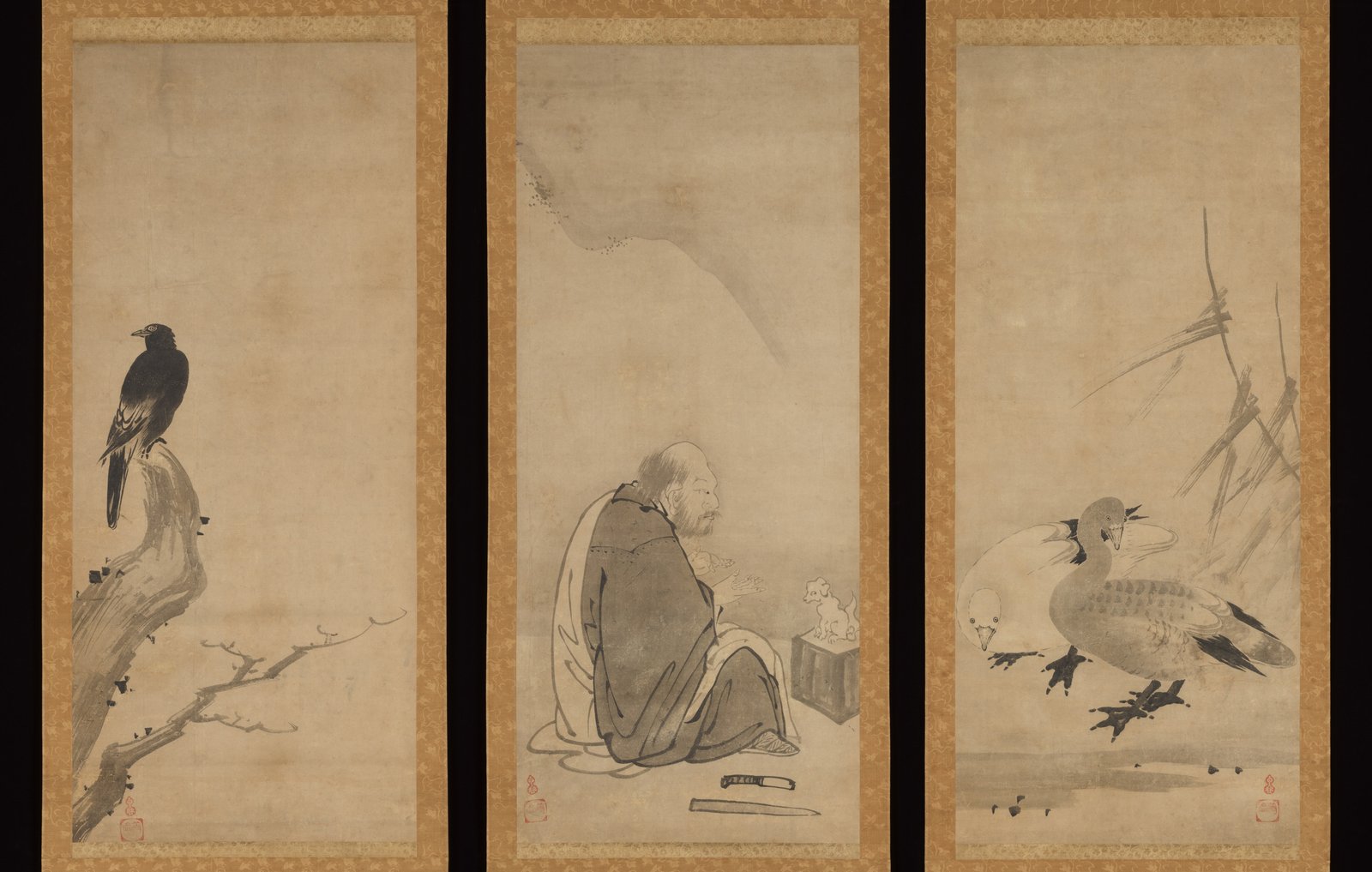
A koan, literally a “public case,” is a recorded encounter, saying or question used in Zen training. Collections include the Blue Cliff Record and the Gateless Barrier. A student’s response is examined within a continuing relationship with a teacher; a clever verbal solution is insufficient.
One famous case asks whether a dog has Buddha-nature. Zhaozhou, called Joshu in Japanese, answers mu, “no” or “not.” In training, the single word can become a focus of inquiry. The tension between the answer and the teaching that beings have Buddha-nature is part of the case. Another famous question associated with Hakuin asks about the sound of one hand. Simply supplying a witty answer misses how such questions are used over time in practice.
In Daniel Quinn’s novel Ishmael, the narrator notices a sign on the wall behind a gorilla.
WITH MAN GONE,
WILL THERE
BE HOPE
FOR GORILLA?This sign stopped me—or rather, this text stopped me. Words are my profession; I seized these and demanded that they explain themselves, that they cease to be ambiguous. Did they imply that hope for gorillas lay in the extinction of the human race or in its survival? It could be read either way.
It was, of course, a koan—meant to be inexplicable.
Daniel Quinn, Ishmael (1992), p. 9.
Wikipedia contributors. Zen. Source · Contributor history · CC BY-SA 4.0.
In Chinese Chan and Korean Seon, the practice of "observing the huatou" (hwadu in Korean) is widely practiced. It was taught by Seon masters like Chinul (1158–1210) and Seongcheol (1912–1993), and modern Chinese masters like Sheng Yen and Xuyun.
Kōan-inquiry may be practiced during zazen (sitting meditation), kinhin (walking meditation), and throughout all the activities of daily life. The goal of the practice is often termed kensho (seeing one's true nature), and is to be followed by further practice to attain a natural, effortless, down-to-earth state of being, the "ultimate liberation", "knowing without any kind of defilement". This style of kōan practice is particularly emphasized in modern Rinzai, but it also occurs in other schools or branches of Zen depending on the teaching line.
Kensho means “seeing one’s nature”; satori also names awakening or realization. Teachers differ over their use and assessment. Insight is expected to inform continued training and conduct.
13. Chanting, work and temple life
Wikipedia contributors. Zen. Source · Contributor history · CC BY-SA 4.0.
Zen monasteries (伽藍, pinyin: qiélán, Jp: garan, Skt. saṃghārāma) will often rely on Zen monastic codes like the Rules of Purity in the Chan Monastery and Dogen's Pure Standards for the Zen Community (Eihei Shingi) which regulate life and behavior in the monastery. Zen monasteries often have a specific building or hall for meditation, the zendō (禅堂, Chinese: Chantáng), as well as a "Buddha hall" (佛殿, Ch:, Jp: butsuden) used for ritual purposes which houses the "main object of veneration" (本尊, Ch: běnzūn, Jp: honzon), usually a Buddha image. Life in a Zen monastery is often guided by a daily schedule which includes periods of work, group meditation, rituals, and formal meals.
Serious Zen practitioners may practice intensive group meditation. In Japanese, this practice is called sesshin. While the daily routine may require monks to meditate for several hours, during the intensive period, they devote themselves almost exclusively to Zen practice. The numerous 30–50 minute long sitting meditation (zazen) periods are interwoven with rest breaks, ritualized formal meals (Jp. oryoki), and short periods of work (Jp. samu) that are to be performed with the same state of mindfulness. In modern Buddhist practice in Japan, Taiwan, and the West, lay students often attend these intensive practice sessions or retreats. These are held at many Zen centers or temples.
Most Zen monasteries, temples, and centers perform various rituals, services, and ceremonies (such as initiation ceremonies and funerals), which are always accompanied by the chanting of verses, poems, or sutras. There are also ceremonies that are specifically for the purpose of sutra recitation (Ch. niansong, Jp. nenju) itself. Zen schools may have an official sutra book that collects these writings (in Japanese, these are called kyohon). Practitioners may chant major Mahayana sutras such as the Heart Sutra and chapter 25 of the Lotus Sutra (often called the "Avalokiteśvara Sutra"). Dhāraṇīs and Zen poems may also be part of a Zen temple liturgy, including texts like the Song of the Precious Mirror Samadhi, the Cantongqi/Sandokai, the Nīlakaṇṭha Dhāraṇī, and the Uṣṇīṣa Vijaya Dhāraṇī Sūtra.
The butsudan is the altar in a monastery, temple, or a lay person's home, where offerings are made to the images of the Buddha, bodhisattvas, and deceased family members and ancestors. Rituals usually center on major Buddhas or bodhisattvas like Avalokiteśvara (see Guanyin), Kṣitigarbha and Manjushri. An important element in Zen ritual practice is the performance of ritual prostrations (Jp. raihai) or bows, usually done in front of a butsudan.
Zen temples hold ceremonies and memorial services as well as meditation sessions. A household may know its priest chiefly through funerals. This helps explain why an account of Zen limited to retreats would miss much of temple life.
Sarah Shaw / The British Library. Buddhist meditation and chant (2021), republished in Huma 207: Exploring the Arts and Culture of the World. Source · CC BY-NC-SA 4.0.
Such images were and are used as objects of devotion. The person sitting or kneeling in front of them makes offerings of flowers, lights and incense, and meditates or chants. This is a way of paying homage, honouring, and hoping that the qualities in the image might arise in them too. The Buddha represents the human mind at its full potential, with great understanding, calm and a profound wisdom. Buddhism suggests that this awakened wisdom and peace is possible in all human beings too, but needs to be cultivated, or found. Just by sitting in front of the figure, and paying respects to it, Buddhists, or sometimes those just interested in Buddhism, can also feel intuitively a connection with the Buddhist path and the way to freedom. So some meditations are chants, refuges to the Buddha, to his teaching, and to his followers. There are also longer chants, called ‘recollections’ (anusṃrti/anussati), reflections on the possibilities of an awake mind, the teaching that can bring this, and other beings who have followed and teach the path to freedom.
Most Buddhists chant to help their daily life. Many people take the ‘refuges’, the protection of the Buddha, the teaching (dhamma), and the community of followers (sangha). They often commit to the five precepts too: undertakings not to harm others, not to steal, not to use the body for sexual activity that can harm self and others, not to lie, and not to become intoxicated. These support the ethical part of the eightfold path: right speech, action and livelihood. Following the precepts ensures the path is whole; they are seen as protective, so meditation and daily life will be safe and not cause harm or worry. All forms of Buddhism regard them as important.
The Heart Sutra is chanted in both Tibetan and East Asian Buddhist traditions. The reader provides a complete translation from Tibetan, with a narrative opening and conclusion. Many Zen liturgies use a shorter version transmitted through Chinese. Their wording and ritual setting can differ. In both, “emptiness” challenges the idea that things exist independently, through an unchanging nature of their own; it is not a claim that suffering or other people do not matter.
14. Art and communities beyond Asia
Wikipedia contributors. Zen. Source · Contributor history · CC BY-SA 4.0.
Zen paintings are sometimes termed zenga in Japanese. Hakuin is one Japanese Zen master who was known to create a large corpus of unique sumi-e (ink and wash paintings) and Japanese calligraphy to communicate zen in a visual way. His work and that of his disciples were widely influential in Japanese Zen. Another example of Zen arts can be seen in the short-lived Fuke sect of Japanese Zen, which practiced a unique form of "blowing zen" (suizen 吹禅) by playing the shakuhachi bamboo flute.
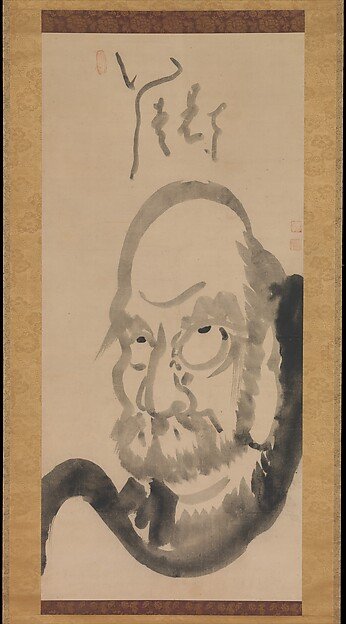
Gardens, calligraphy, poetry, flower arranging and tea practice have been associated with Zen institutions and teachers. These arts also have histories beyond Zen; a simple-looking garden or a tea bowl is not automatically a religious object. Hakuin (1686–1769), a major Rinzai teacher, used brush painting and calligraphy as part of teaching. His works can combine humor, strong emotion and religious instruction.
Wikipedia contributors. Zen. Source · Contributor history · CC BY-SA 4.0.
Various Zen traditions were transmitted to the West in the 20th century. Important Asian figures in this transmission include Soyen Shaku, D. T. Suzuki, Nyogen Senzaki, Sokei-an, Shunryu Suzuki, Taizan Maezumi, Hsuan Hua, Sheng-yen, Seung Sahn, Taisen Deshimaru, Thích Thiên-Ân and Thích Nhất Hạnh. Among the first Western Zen teachers were Ruth Fuller Sasaki, Philip Kapleau, Robert Baker Aitkin, Walter Nowick, Brigitte D'Ortschy, Hōun Jiyu-Kennett and Myokyo-ni. Zen became more popular in the West when authors including Jack Kerouac, Allen Ginsberg, Alan Watts, Gary Snyder, Erich Fromm, Robert Pirsig and Eugen Herrigel wrote on and promoted Zen. There are currently numerous Zen centers from various traditions in the Western world, including Rinzai, Sōtō, Plum Village, Chinese Chan and Kwan Um.
Migrant families, Asian American temples, Tibetan refugees and converts have established institutions with different languages and priorities. Family observances and communal responsibilities belong to their histories alongside famous teachers and meditation centers.
15. Read, compare and explain
- Explain bodhicitta using two specific practices from Tokme Zangpo’s poem. How do the practices connect wisdom with conduct?
- Distinguish a lama, a tulku, the Dalai Lama and the Ganden Tripa. Which terms describe a teaching role, and which name a particular office or recognized lineage?
- Retell Padmasambhava’s story. What do spirits becoming protectors and hidden treasures explain for his followers? How does Mang distinguish later narratives from earlier evidence?
- Compare the emperor’s question about merit with Huineng’s reply about Buddha-nature. What assumption does each story challenge?
- Explain how koan training differs from answering a riddle. Why does a teacher’s assessment matter?
- Use the temple-life passages to correct an account that describes Zen only as silent individual meditation.
- In the Heart Sutra, what does Avalokiteshvara tell Shariputra to examine? Compare this with the five aggregates in Chapter 5.
- Compare the last two cowherding scenes with the bodhisattva’s commitment to other beings. Why might a sequence of training end in a city?
Words to be able to explain: bodhicitta, Vajrayana, Nyingma, Kagyu, Sakya, Gelug, lama, tulku, terma, mantra, mandala, bardo, Chan/Zen, Buddha-nature, zazen, shikantaza, koan, kensho.
Primary readings
Read the primary texts for Chapter 6. This separate page contains the assigned passages, translation credits and reading questions.