CA-ROTEL World Religions · Chapter 7
Daoism: Living with the Way
Previous: Tibetan and Zen Buddhism · Extended primary readings · Sources
A cook handles a knife; a writer dreams he is a butterfly; worshippers bring offerings to a temple. Daoist texts and practices place these different activities within questions about living with the Way.
Attributed readings are woven through the chapter. Brief unboxed explanations provide definitions, historical context and connections. The companion reader embeds all assigned primary selections.
1. Daoism within Chinese religious life
Daoist texts praise simplicity and flexibility, and question restless ambition. Daoist communities also maintain temples, train priests and cultivate long life. Their writings and institutions have developed together over centuries.
Daoism and Taoism are different spellings of the same name. This chapter generally uses modern pinyin spellings: Dao, Laozi, Daodejing, Zhuangzi and qi. Older readings use Tao, Lao Tzŭ, Tao Te Ching, Chuang Tzŭ and ch’i. A change of spelling does not by itself indicate a change of religion.
Nathan Smith / OpenStax. Introduction to Philosophy (2022), §9.5 “Daoism”. Source · CC BY-NC-SA 4.0.
Daoism (also written as Taoism) finds its beginnings during the Warring States period of ancient China. Like Mohism and Confucianism, Daoism is a response to the social unrest and suffering characteristic of that period. Daoism aims to foster harmony in both society and the individual. To do so, it seeks to understand the source of evil and suffering. It locates the cause of most suffering and conflict in desires and greed. Daoists believe that even when we try to regulate human action with moral systems and norms, we still fail to realize a flourishing society and good life. Harmony is possible by living life in accordance with what is natural. While Mohism and consequentialism judge the morality of an action based on the happiness it creates, Daoism equates moral actions with those that promote harmony and accord with the natural way.
Chinese religious life does not always fit a model of separate, exclusive memberships. A family may honor ancestors, consult a Daoist priest and take part in Buddhist observances. Confucian teachings may shape its duties and ceremonies. These “three teachings” have interacted for centuries. Daoism is one identifiable tradition within this wider setting, rather than a name for everything religious in China.
Long before the earliest Daoist texts, Chinese communities made offerings to ancestors and powerful spirits. Rulers used divination to seek guidance. Tian, often translated “Heaven,” could refer to a moral or divine order as well as the sky. These older practices and ideas continued to develop alongside Daoism. Ancestor veneration, divination and the Yijing or Book of Changes are shared parts of Chinese cultural history, rather than exclusively Daoist possessions.
2. Laozi and the book at the border
The Daodejing, “Classic of the Way and Its Power,” is traditionally attributed to Laozi, the “Old Master.” A familiar story places its composition at a border crossing as he leaves a corrupt society. Emily Mark recounts it below.
Emily Mark; ATD attribution key (25). “Taoism,” Ancient History Encyclopedia, reproduced in ATD World Religions. Source · CC BY-NC-SA 3.0.
As he was leaving China through the western pass, the gatekeeper Yin Hsi stopped him because he recognized him as a philosopher. Yin Hsi asked Lao-Tzu to write a book for him before he left civilization forever and Lao-Tzu agreed. He sat down on a rock beside the gatekeeper and wrote the Tao-Te-Ching (The Book of the Way) . He stopped writing when he felt he was finished, handed the book to Yin Hsi, and walked through the western pass to vanish into the mist beyond. Sima Qian does not continue the story after this, but presumably (if the story is true) Yin Hsi would have then had the Tao-Te-Ching copied and distributed.
The border story supplies the book with an author and an occasion. The manuscripts from Guodian and Mawangdui provide a different kind of evidence: early versions varied in wording, order and contents. Their differences prevent treating the received eighty-one chapters as an unchanged book from one securely documented moment. The Stanford Encyclopedia of Philosophy entry on Laozi discusses this textual evidence.
The Zhuangzi is the other early classic most often read beside the Daodejing. Each has a distinctive style and a complex history of interpretation.
These are two foundational classics, but Daoist scriptures extend far beyond them. The Daozang, or Daoist Canon, gathers scriptures, ritual works, commentaries and writings on cultivation. It is a large collection, not one book that every worshipper reads from beginning to end.
Wikipedia contributors. “Taoism”. Source · contributor history · CC BY-SA 4.0.
In practice, Taoist communities and lineages typically draw on selected texts (often transmitted through teachers, ritual training, and local institutions) rather than treating the Daozang as a single, uniformly consulted book, though it remains a central reference for Taoist liturgy, doctrine, and textual study.
3. The Dao: the Way that words cannot contain
Nathan Smith / OpenStax. Introduction to Philosophy (2022), §9.5 “Daoism”. Source · CC BY-NC-SA 4.0.
In Daoism, the dao is often translated as “the way.” Daoists rejected the narrow Confucian view of dao as a way of behaving in society to ensure order and social harmony, and instead view the dao as the natural way of the universe and all things. The dao is represented as the source or origin of all that exists. Daoism tells us that we must live in accord with the dao if we want to live a good life or live well.
In ordinary Chinese, dao can mean a road, a way of doing something or a teaching. Daoist writers give it a larger reach: the source and course of the world’s transformations. Their repeated warning is that naming it does not capture it. Read the opening chapter slowly. Legge’s “Mother of all things” is one image for how things arise; “Mystery” marks the limits of a neat explanation.
Laozi (traditional attribution); translated by James Legge (1891). Tao Te Ching, Standard Ebooks edition. Source · Public-domain source text; edition contributions CC0.
Daodejing 1
The Tao that can be trodden is not the enduring and unchanging Tao. The name that can be named is not the enduring and unchanging name.
(Conceived of as) having no name, it is the Originator of heaven and earth; (conceived of as) having a name, it is the Mother of all things.
Always without desire we must be found,
If its deep mystery we would sound;
But if desire always within us be,
Its outer fringe is all that we shall see.
Under these two aspects, it is really the same; but as development takes place, it receives the different names. Together we call them the Mystery. Where the Mystery is the deepest is the gate of all that is subtle and wonderful.
Water benefits living things and flows around obstacles; a valley receives what enters it; an uncarved block retains possibilities a finished object has lost. The Daodejing uses these images to question ambition and attempts at control.
Laozi (traditional attribution); translated by James Legge (1891). Tao Te Ching, Standard Ebooks edition. Source · Public-domain source text; edition contributions CC0.
Daodejing 8
The highest excellence is like (that of) water. The excellence of water appears in its benefiting all things, and in its occupying, without striving (to the contrary), the low place which all men dislike. Hence (its way) is near to (that of) the Tao.
The excellence of a residence is in (the suitability of) the place; that of the mind is in abysmal stillness; that of associations is in their being with the virtuous; that of government is in its securing good order; that of (the conduct of) affairs is in its ability; and that of (the initiation of) any movement is in its timeliness.
And when (one with the highest excellence) does not wrangle (about his low position), no one finds fault with him.
De, the second word in Daodejing, is translated as virtue, power or efficacy. It concerns the character and capacity of a being that lives in accord with the Way. The text’s sage is someone whose conduct gives these teachings visible form.
4. Wuwei and naturalness
Nathan Smith / OpenStax. Introduction to Philosophy (2022), §9.5 “Daoism”. Source · CC BY-NC-SA 4.0.
The Daoist approach to life is one that recommends reserve, acceptance of the world as it is, and living in accordance with the flow of nature. In ancient China, Laozi and other thinkers responded to the unrest, conflict, and suffering they witnessed in their society. Laozi’s response (and Zhuangzi’s development of it) is critical of the way we normally live in the world. For example, we are normally wasteful, we resist change, and we try to transform the natural world to suit our needs. Daoism recommends instead that we move with the current of the natural way of things, accept things as they are, and find balance and harmony with the dao. The Daoist call this the practice of wu wei, which involves what is often described as nonaction (Chan 2018). Offering a clear account of wu wei can prove challenging because it is a paradoxical concept. Our normal concept of action includes motivated, directed, purposeful activity aimed at desire satisfaction. To act is to impose your strength and will on the world, to bring something about. Practicing wu wei, in contrast, suggests a natural way of acting that is spontaneous or immediate. When you practice wu wei, you act in harmony with the dao, you are free of desire and of striving, and you spontaneously move with the natural flow of existence.
One who practices wu wei, or nonaction, is someone free of unnecessary, self-gratifying desires. The normal way we act in the world fosters an attitude of separateness and causes us to act against nature or in ways that resist the natural way. Practicing nonaction brings one in harmony with the dao. The individual develops an attitude of connectedness rather than individuality, of being one with the natural world and the way of things rather than separate from or against it.
Wuwei is often translated “nonaction,” but the cook’s story shows sustained activity without wasteful force. Ziran, “naturalness” or “spontaneity,” names a related ideal. Years of practice enable the cook to respond freely to what he encounters.
Zhuangzi; translated by Herbert A. Giles (1889). Chuang Tzu: Mystic, Moralist, and Social Reformer. Source · Public domain in the United States.
Prince Hui's cook was cutting up a bullock. Every blow of his hand, every heave of his shoulders, every tread of his foot, every thrust of his knee, every whshh of rent flesh, every chhk of the chopper, was in perfect harmony,—rhythmical like the dance of the Mulberry Grove, simultaneous like the chords of the Ching Shou.
"Well done!" cried the Prince. "Yours is skill indeed."
"Sire," replied the cook; "I have always devoted myself to Tao. It is better than skill. When I first began to cut up bullocks, I saw before me simply whole bullocks. After three years' practice, I saw no more whole animals.
And now I work with my mind and not with my eye. When my senses bid me stop, but my mind urges me on, I fall back upon eternal principles. I follow such openings or cavities as there may be, according to the natural constitution of the animal. I do not attempt to cut through joints: still less through large bones.
"A good cook changes his chopper once a year,—because he cuts. An ordinary cook, once a month,—because he hacks. But I have had this chopper nineteen years, and although I have cut up many thousand bullocks, its edge is as if fresh from the whetstone. For at the joints there are always interstices, and the edge of a chopper being without thickness, it remains only to insert that which is without thickness into such an interstice.
By these means the interstice will be enlarged, and the blade will find plenty of room. It is thus that I have kept my chopper for nineteen years as though fresh from the whetstone.
"Nevertheless, when I come upon a hard part where the blade meets with a difficulty, I am all caution. I fix my eye on it. I stay my hand, and gently apply my blade, until with a hwah the part yields like earth crumbling to the ground. Then I take out my chopper, and stand up, and look around, and pause, until with an air of triumph I wipe my chopper and put it carefully away."
"Bravo!" cried the Prince. "From the words of this cook I have learnt how to take care of my life."
Notice the years of practice and the moment when the cook slows down at a difficult place. His ease includes attention and care. The prince hears a lesson about living: respond to the structure of a situation instead of wearing yourself out by forcing your way through it.
Nathan Smith / OpenStax. Introduction to Philosophy (2022), §9.5 “Daoism”. Source · CC BY-NC-SA 4.0.
The Daoist way of living in the world is one that values being receptive to the natural flow and movements of life. We practice a “soft” style of action when we practice wu wei (Wong 2021). Daoists think we normally practice a “hard” style of action, we resist the natural flow. The common view or understanding of the natural world treats it as separate from the human world, as something valuable only for its usefulness. Such a view promotes values like strength, dominance, and force because we view nature as something that must be overpowered and transformed to fit the human, social world. The Daoist conception of softness suggests living in the world in a way that is in accord with the natural way of things. Instead of acting against the current of the stream, you move easily with the flow of the waters. A “soft” style suggests being receptive to the natural flow and moving with it. When you are sensitive to the natural movements and processes of life, you are free of desire, calm, and able to live in harmony with it.
5. Zhuangzi: stories that change a viewpoint
Zhuang Zhou, commonly called Zhuangzi or “Master Zhuang,” is associated with the fourth century BCE. The book bearing his name contains material from several authors and periods. Its dialogues, jokes and strange characters challenge confidence about what is useful, important or true. They are philosophical stories, not a continuous life history.
Zhuangzi; translated by Herbert A. Giles (1889). Chuang Tzu: Mystic, Moralist, and Social Reformer. Source · Public domain in the United States.
Once upon a time, I, Chuang Tzŭ, dreamt I was a butterfly, fluttering hither and thither, to all intents and purposes a butterfly. I was conscious only of following my fancies as a butterfly, and was unconscious of my individuality as a man. Suddenly, I awaked, and there I lay, myself again. Now I do not know whether I was then a man dreaming I was a butterfly, or whether I am now a butterfly dreaming I am a man. Between a man and a butterfly there is necessarily a barrier. The transition is called Metempsychosis.
Giles’s last word, “metempsychosis,” is an older English rendering; the Chinese expression is commonly translated “transformation of things.” The question is how a person can be certain of the boundary between different experiences and identities. It need not be reduced to a literal claim that every dream reveals a previous life.
Zhuangzi; translated by Herbert A. Giles (1889). Chuang Tzu: Mystic, Moralist, and Social Reformer. Source · Public domain in the United States.
Chuang Tzŭ was fishing in the P'u when the prince of Ch'u sent two high officials to ask him to take charge of the administration of the Ch'u State.
Chuang Tzŭ went on fishing, and without turning his head said, "I have heard that in Ch'u there is a sacred tortoise which has been dead now some three thousand years. And that the prince keeps this tortoise carefully enclosed in a chest on the altar of his ancestral temple. Now would this tortoise rather be dead and have its remains venerated, or be alive and wagging its tail in the mud?"
"It would rather be alive," replied the two officials, "and wagging its tail in the mud."
"Begone!" cried Chuang Tzŭ. "I too will wag my tail in the mud."
The tortoise story weighs honor against being alive and free. The offer is prestigious, but Zhuangzi asks what such prestige would cost. This does not mean that all Daoists withdrew from society. Daoist teachers have also advised rulers, administered communities and performed public rituals.
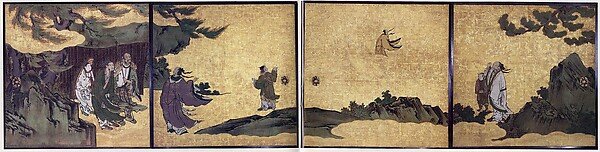
In the Huainanzi, chapter 18, an old man near the frontier loses a horse. It returns with other horses, apparently a stroke of luck. His son then breaks a leg while riding. When men are recruited for war, the injury keeps the son home. Each reversal unsettles the neighbors’ confident judgments about good and bad fortune. This is a retelling of a Han-period story, distinct from the Daodejing. source chapter
6. Yin, yang, qi and the human body
John Mack, in Tim McKenzie, ed.. World Religions, “Daoism”. Source · CC BY-NC-SA 4.0.
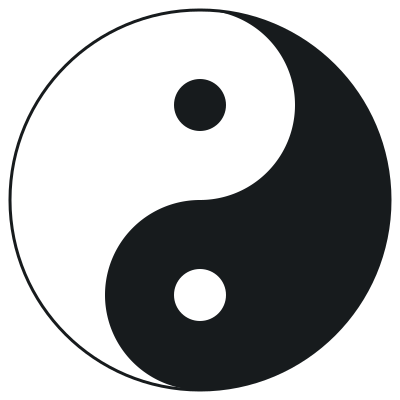
Yin is associated with shade, water, and feminine, and yang, associated with light, fire, and male. They are the two alternating phases of cosmic energy. They are sometimes compared to the north side of a mountain and south side of the same mountain. They are not good or bad, just different sides. Their balance brings cosmic harmony.
The familiar image of the symbol reflects the intertwined duality of all things in nature, a common theme in Daoism. No quality is independent of its opposite, nor so pure that it does not contain its opposite. These concepts are depicted by the division between the portions, and the smaller circles within the large regions.
These are relationships and changing tendencies, not two armies fighting for control of the universe. Night gives way to day; warmth and coolness have their times. The dark side is not evil and the light side is not good. Traditional associations of yin with women and yang with men have also been used within unequal social systems. A complementary diagram by itself does not prove that historical societies treated people equally.
Qi can be translated as breath or vital energy. In traditional Chinese accounts, it connects bodily life with the larger world. It is not simply another name for energy as measured in modern physics. Daoist practitioners have cultivated breathing, diet, movement and meditation in order to nourish life. They have also described the body as a microcosm, a smaller world whose patterns correspond to the cosmos.
Wikipedia contributors. “Taoism”. Source · contributor history · CC BY-SA 4.0.
Taoist longevity methods are closely related to ancient Chinese medicine. Many of these methods date back to Tang dynasty figures like alchemist Sun Simiao (582–683) and the Highest Clarity Patriarch Sima Chengzhen (647–735). The goal of these methods ranges from better health and longevity to immortality. Key elements of these "nourishing life" (yangsheng) methods include moderation in all things (drink, food, etc.), adapting to the cycles of the seasons by following injunctions regarding healing exercises (daoyin), and breathwork.
A number of physical practices, like modern forms of qigong, as well as modern internal martial arts (neijia) like Taijiquan, Baguazhang, Xingyiquan, and Liuhebafa, are practiced by Taoists as methods of cultivating health and longevity as well as eliciting internal alchemical transformations. However, these methods are not specifically Taoist and are often practiced outside of Taoist contexts.
The five phases—wood, fire, earth, metal and water—provide another way of describing patterns of change. They are used across Chinese medicine, cosmology and other fields. Like yin and yang, they have histories beyond Daoism. Practices such as taijiquan, often spelled tai chi, can likewise be practiced in Daoist settings or without a Daoist religious commitment.
7. Communities, revelations and the Celestial Masters
Daoist history includes new revelations, scriptures and communities alongside interpretation of the classics. Temple worship and bodily cultivation developed within these histories; they cannot be explained simply as a later corruption of philosophy.
Wikipedia contributors. “Taoism”. Source · contributor history · CC BY-SA 4.0.
The first organized form of Taoism was the Way of the Celestial Masters, which developed from the Five Pecks of Rice movement at the end of the 2nd century CE. The latter had been founded by Zhang Daoling, who was said to have had a vision of Laozi in 142 CE and claimed that the world was coming to an end. Zhang sought to teach people to repent and prepare for the coming cataclysm, after which they would become the seeds of a new era of great peace. It was a mass movement in which men and women could act as libationers and tend to the commoners. A related movement arose in Shandong called the "Way of Great Peace", seeking to create a new world by replacing the Han dynasty. This movement led to the Yellow Turban Rebellion, and after years of bloody war, they were crushed.
The tradition remembers Zhang Daoling receiving a revelation from the divine Lord Lao in 142 CE. The teacher who disappears at the border now appears as a divine revealer. Followers formed communities with appointed religious leaders, registers, confession and petitions to celestial powers. The name “Five Pecks of Rice” refers to contributions associated with the movement. The Celestial Masters should be distinguished from the related Great Peace movement behind the Yellow Turban uprising of 184 CE.
Later traditions added further scriptures and practices. Shangqing, or Highest Clarity, developed from fourth-century revelations and is especially associated with visualization and the divine world within the body. Lingbao, or Numinous Treasure, developed a powerful ritual and scriptural tradition, interacting with Buddhism. Such developments helped create the large and varied Daoist canon.
Wikipedia contributors. “Taoism”. Source · contributor history · CC BY-SA 4.0.
During the Tang, several emperors became patrons of Taoism, inviting priests to court to conduct rituals and enhance the prestige of the sovereign. The Gaozong Emperor even decreed that the Tao Te Ching was to be a topic in the imperial examinations. During the reign of the 7th century Emperor Taizong, the Five Dragons Temple (the first temple at the Wudang Mountains) was constructed. Wudang would eventually become a major center for Taoism and a home for Taoist martial arts (Wudang quan).
Likewise, several Song dynasty emperors, most notably Huizong, were active in promoting Taoism, collecting Taoist texts, and publishing updated editions of the Daozang. The Song era saw new scriptures and new movements of ritualists and Taoist rites, the most popular of which were the Thunder Rites (leifa). The Thunder rites were protection and exorcism rites that evoked the celestial department of thunder, and they became central to the new Heavenly Heart (Tianxin) tradition as well as for the Youthful Incipience (Tongchu) school.
Imperial favor was uneven. An emperor might patronize Daoists while also supporting Buddhist and Confucian institutions. Daoist communities could gain protection and resources from rulers, and could also suffer restrictions, rivalry and loss. Their history cannot be told as one uninterrupted period of state approval.
8. Zhengyi, Quanzhen and the search for long life
Two major families of Daoist traditions today are Zhengyi, “Orthodox Unity,” and Quanzhen, “Complete Perfection.” Zhengyi is connected to the Celestial Masters and is especially associated with trained priests serving communities. Many Zhengyi priests marry and live outside monasteries. Quanzhen developed in the twelfth century around Wang Chongyang (1113–1170) and his disciples. It places strong emphasis on disciplined cultivation and monastic life, although the variety within each family is considerable.
Stories of Wang’s encounters with immortals explain his turn toward religious practice. Quanzhen teachers drew on Buddhist and Confucian learning as well as Daoist traditions. Sun Bu’er, one of its early masters, is an important example of women’s teaching authority. Context sources
Wikipedia contributors. “Taoism”. Source · contributor history · CC BY-SA 4.0.
A key element of many schools of Taoism are alchemical practices, which include rituals, meditations, exercises, and the creation of various alchemical substances. The goals of alchemy include physical and spiritual transformation, aligning oneself spiritually with cosmic forces, undertaking ecstatic spiritual journeys, improving physical health, extending one's life, and even becoming an immortal (xian).
External alchemy (waidan) works with substances outside the body. Some historical elixirs contained mercury or other toxic materials, and the quest for long life could itself be fatal. Internal alchemy (neidan) uses a language of refining essence, breath and spirit to describe transformation within the practitioner. Its methods may include meditation, visualization and breathing, transmitted through teachers.
Xian is often translated “immortal” or “transcendent.” Its meanings vary: a deathless perfected body, a transformed spiritual existence, or an ideal realized person. A full account of Daoism must allow for both the search for long life and the acceptance of death found in some of its most famous stories.

9. Deities and immortals

The Dao is not usually presented as a personal creator who stands apart from the world. This does not make Daoist religious life empty of gods. Daoist communities honor many divine beings, and their identities and ranks can vary across places and traditions.
Wikipedia contributors. “Taoism”. Source · contributor history · CC BY-SA 4.0.
Next, the Three Pure Ones are generally treated as the highest "manifestations" of the Dao: Yuanshi Tianzun ("Original and Primordial Heavenly Lord"), Lingbao Tianzun ("Divine Treasures Heavenly Lord"), and Daode Tianzun ("Heavenly Lord of Way and Virtue"). In many contexts, Daode Tianzun is seen as the deified form of Laozi, which ties this third “Pure One” to the Tao Te Ching and to Laozi’s role as revealer/teacher.
Underneath the Three Pure Ones, the next ruling power is the Jade Emperor (Yuhuang Dadi, 玉皇大帝). If the Three Pure Ones are like supreme “principles,” the Jade Emperor is the administrator of the cosmos. He functions as the sovereign ruler of heaven who administers the cosmos through a vast celestial bureaucracy modeled on the imperial court of ancient China. He is assisted by the Four Heavenly Ministers (四御) (sometimes extended to six in later traditions), high-ranking “deputy” sovereigns who oversee major cosmic domains.
Finally, Taoism frequently integrated local tutelary deities associated with particular places, especially earth/land gods such as Tudigong (土地公, “Lord of the Land”), a locality guardian whose jurisdiction is limited to a specific area (such as a village, temple compound, neighborhood block, or building).
The titles Three Pure Ones refer to the Celestial Worthies of Primordial Beginning, Numinous Treasure, and the Way and Its Power. The last is closely associated with the deified Laozi. The Jade Emperor is portrayed as a cosmic ruler with officials and departments. The organization resembles an imperial administration: petitions, reports and registers connect human requests with celestial authority.
Other popular figures include the Queen Mother of the West, the Eight Immortals and numerous local protectors. A land god, city god or household deity may matter greatly to a particular community. Some figures, such as Mazu, are honored across overlapping Daoist and popular religious settings. The presence of one image in a temple does not tell us everything about the worshippers’ religious affiliations.
Stories of Lü Dongbin, one of the Eight Immortals, give renunciation a memorable form. In the yellow-millet-dream legend, he falls asleep while a meal cooks. He dreams of an entire life of success, family, disgrace and loss. When he wakes, the millet is not yet ready. His encounter with an immortal teacher turns his attention from official advancement toward cultivation. Versions differ, but the compressed lifetime makes the instability of worldly success vivid. See the legend and its sources.
Mazu is remembered as a woman who helped people at sea and became a protector after death. Stories of rescue accompany household offerings, temple fairs and processions. Devotion traveled with coastal communities and migrants, connecting places across the sea. UNESCO documents these practices. UNESCO’s account of Mazu belief and customs

10. Temples, ritual and moral conduct
Wikipedia contributors. “Taoism”. Source · contributor history · CC BY-SA 4.0.
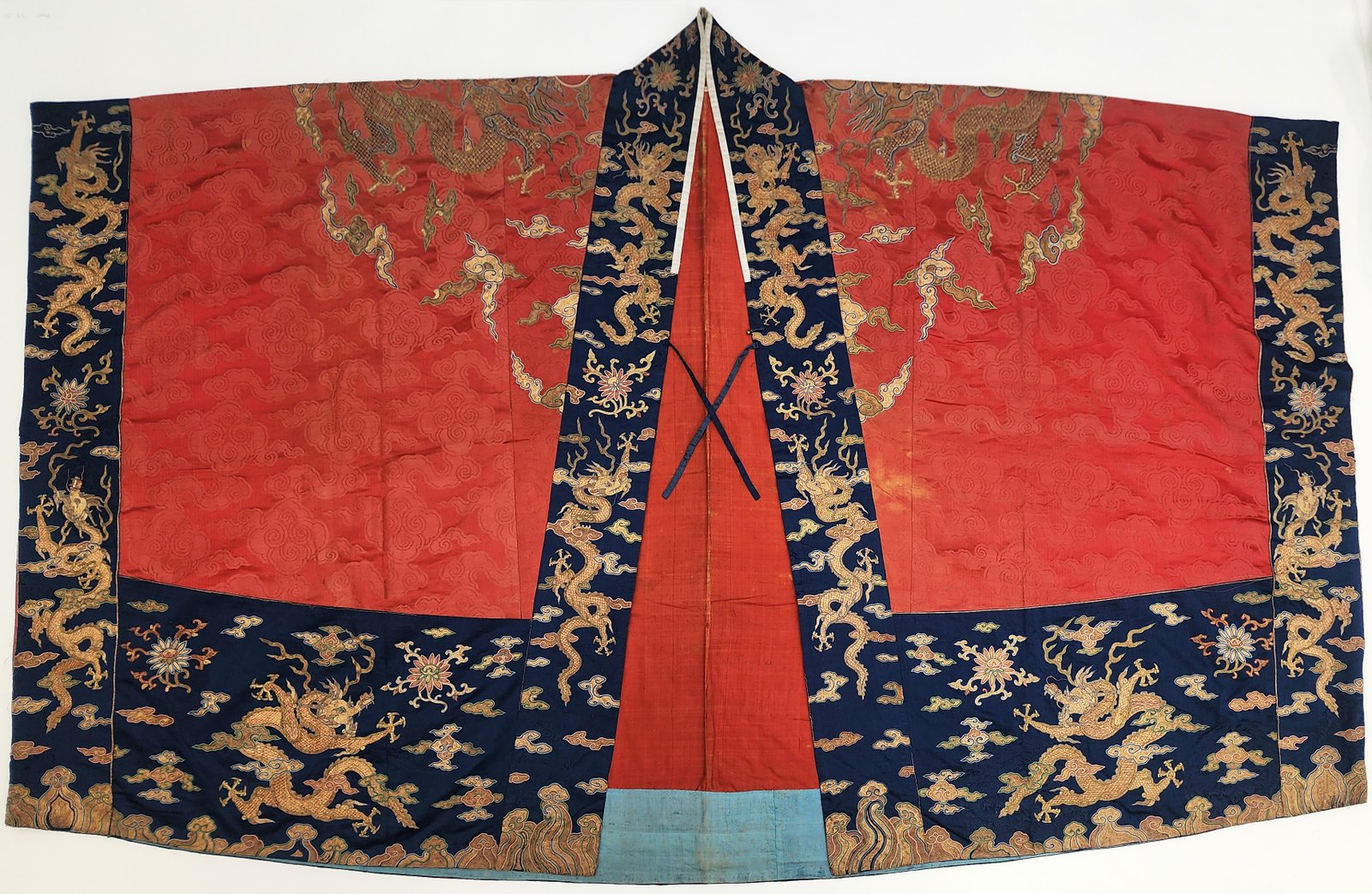
Taoist ritual practice includes a wide range of activities, such as making offerings; reciting and reading scriptures; chanting and incantations; purification, confession, and repentance rites; submitting petitions and memorials and issuing formal announcements to the deities; observing ethical precepts; delivering lectures; and holding communal feasts.
A temple may hold images, altars and ritual texts, while worshippers bring incense, food, flowers or other offerings. Priests train in chants, music, gestures and written ritual procedures. In a jiao, a communal offering or renewal ceremony, a community seeks to restore order and its relationship with divine powers. A zhai involves purification or retreat; the terms have different uses across periods and traditions. Ritual precision is part of a practitioner’s training and service.
John Mack, in Tim McKenzie, ed.. World Religions, “Daoism”. Source · CC BY-NC-SA 4.0.
In addition to these central figures, regional deities and traditional Chinese gods are also revered in Daoist practice. These gods are often associated with specific aspects of nature, human life, or the cosmos, and are revered as manifestations of the Dao’s creative power. By honoring these gods, Daoists seek to align themselves with the natural world and the eternal cycle of the Dao, cultivating a life of balance, harmony, and spiritual growth.
John Mack, in Tim McKenzie, ed.. World Religions, “Daoism”. Source · CC BY-NC-SA 4.0.
In addition to these rituals, Daoists also observe several traditional Chinese festivals each year. These festivals follow the lunar calendar, which is an essential part of Chinese culture and tradition. Some of the most significant festivals include the Lunar New Year (Spring Festival), the Lantern Festival, and the Mid-Autumn Festival. These celebrations often involve rituals, ceremonies, and other sacred activities that bring people together and honor the harmony of the cosmos.
These festivals belong to wider Chinese life as well as Daoist communities. Celebrations of particular deities’ birthdays, temple processions and local calendars add further occasions. Some household worship requires no priest, while complex public ceremonies depend on specialists. Daoist life includes both personal cultivation and obligations to other people.
John Mack, in Tim McKenzie, ed.. World Religions, “Daoism”. Source · CC BY-NC-SA 4.0.
Daoist ethics are built on the view that life should be lived quietly and in harmony with dao. To attain unity with dao, a person must practice self-cultivation because human nature does not automatically align itself with dao. Oneness with dao requires training and cultivation, like a garden. Just as weeds must be meticulously pulled from a garden, vices must be uprooted from one’s life. Daoist ethical principles include nonviolence, quietism, honesty, and harmony with nature and one’s neighbors. Through self-cultivation, Daoists learn to conform their thoughts and actions to dao, which results in transformation. Eventually, Daoists hope to be transformed to the extent that moral behavior becomes spontaneous.
The Daodejing names three treasures through which it connects restraint with care for others:
Laozi (traditional attribution); translated by James Legge (1891). Tao Te Ching, Standard Ebooks edition. Source · Public-domain source text; edition contributions CC0.
Daodejing 67
All the world says that, while my Tao is great, it yet appears to be inferior (to other systems of teaching). Now it is just its greatness that makes it seem to be inferior. If it were like any other (system), for long would its smallness have been known!
But I have three precious things which I prize and hold fast. The first is gentleness; the second is economy; and the third is shrinking from taking precedence of others.
With that gentleness I can be bold; with that economy I can be liberal; shrinking from taking precedence of others, I can become a vessel of the highest honour. Nowadays they give up gentleness and are all for being bold; economy, and are all for being liberal; the hindmost place, and seek only to be foremost;—(of all which the end is) death.
Gentleness is sure to be victorious even in battle, and firmly to maintain its ground. Heaven will save its possessor, by his (very) gentleness protecting him.
The Taishang ganying pian, or Tract on Actions and Their Responses, makes moral consequences concrete. It pictures divine powers keeping account of conduct. The companion reader contains the entire tract in Legge’s translation. Here is part of its account of a good person:
Traditional attribution to the Most High Lord Lao; translated by James Legge (1891). The Thâi-Shang Tractate of Actions and Their Retributions, The Texts of Taoism, Part II, pp. 235–246. Source · Public domain in the United States.
'He ought to pity the malignant tendencies of others; to rejoice over their excellences; to help them in their straits; to rescue them from their perils; to regard their gains as if they were his own, and their losses in the same way; not to publish their shortcomings; not to vaunt his own superiorities; to put a stop to what is evil, and exalt and display what is good; to yield much, and take little for himself; to receive insult without resenting it, and honour with an appearance of apprehension; to bestow favours without seeking for a return, and give to others without any subsequent regret:--this is what is called a good man.
This moral tract praises helping people in difficulty, protecting living things, restraint and generosity. It also reflects the family hierarchy and ritual expectations of its historical setting. Its account of rewards and punishments belongs to a religious explanation of moral order. Compare its detailed instructions with the Daodejing’s questions about whether imposed rules make people better.
11. Death, mourning and transformation
Daoist traditions do not offer one uniform account of death. Religious communities have performed rites for ancestors and the dead, sought favorable destinies for spirits, and imagined immortal realms. Such practices have developed alongside Buddhist and other Chinese funerary traditions. Family responsibility, continued remembrance and the assistance of religious specialists can all matter.
John Mack, in Tim McKenzie, ed.. World Religions, “Daoism”. Source · CC BY-NC-SA 4.0.
Daoism honors the tradition of offering gifts to the dead. These gifts often are effigies of desirable objects, such as cars and houses. These effigies are burned as offerings to provide comfort to the departed spirits, as many Daoists believe that their departed loved ones will receive these items in the next life or in the spirit world.
Paper offerings are one practice in wider Chinese religious life, not something every Daoist family performs. They should also be distinguished from Daoist funeral liturgies, which can involve purification, petitions and deliverance of the dead. In contrast to a ceremony’s careful procedures, the Zhuangzi offers a personal story of grief and change:
Zhuangzi; translated by Herbert A. Giles (1889). Chuang Tzu: Mystic, Moralist, and Social Reformer. Source · Public domain in the United States.
When Chuang Tzŭ's wife died, Hui Tzŭ went to condole. He found the widower sitting on the ground, singing, with his legs spread out at a right angle, and beating time on a bowl.
"To live with your wife," exclaimed Hui Tzŭ, "and see your eldest son grow up to be a man, and then not to shed a tear over her corpse,—this would be bad enough. But to drum on a bowl, and sing; surely this is going too far."
"Not at all," replied Chuang Tzŭ. "When she died, I could not help being affected by her death. Soon, however, I remembered that she had already existed in a previous state before birth, without form, or even substance; that while in that unconditioned condition, substance was added to spirit; that this substance then assumed form; and that the next stage was birth. And now, by virtue of a further change, she is dead, passing from one phase to another like the sequence of spring, summer, autumn, and winter. And while she is thus lying asleep in Eternity, for me to go about weeping and wailing would be to proclaim myself ignorant of these natural laws. Therefore I refrain."
Zhuangzi says that he was affected by the death. The story’s question is what happens when grief is considered within the larger transformations of life. It offers a challenge to ordinary mourning, not a rule that every Daoist must drum and sing at a funeral.
12. Daoism in the modern world
Daoist communities have experienced political change, war, restrictions on religion and destruction of temples. During the Cultural Revolution of 1966–1976, religious institutions in mainland China were severely damaged. The reforms beginning in the late 1970s allowed rebuilding, although religious activity remains subject to state regulation. Communities in Taiwan, Hong Kong and other parts of the Chinese diaspora have followed different histories.
Wikipedia contributors. “Taoism”. Source · contributor history · CC BY-SA 4.0.
Taoism began to recover during the reform and opening up period (beginning in 1979) during which mainland China experienced increased religious freedom. This led to the restoration of many temples and communities, the publishing of Taoist literature and the preservation of Taoist material culture.
Migration has carried Daoist worship and religious specialists to Southeast Asia, Europe and the Americas. Chinese-language temples and household traditions sustain practices that English translations alone cannot convey.
Modern ecological readings draw on Daoist images of water, naturalness and restraint. These interpretations are part of the texts’ later reception. They do not establish that all Daoist communities share one environmental program.
13. Read, compare and explain
- Retell Laozi’s departure at the border. What does the story explain, and what questions do historians ask about the book’s origins?
- Use the complete water chapter and Cook Ding’s story to explain wuwei. Include the cook’s caution when he meets a difficulty.
- Compare the butterfly dream, the tortoise and the farmer’s horse. What kind of certainty or value does each question?
- Explain yin, yang and qi without treating them as good versus evil or as terms from modern physics.
- Distinguish the Celestial Masters, Zhengyi and Quanzhen. How do teachers, rituals, scriptures and communities enter their histories?
- What does the moral tract add to an account of Daoism based only on the Daodejing? What tensions remain?
- Compare the quest for immortality with the story of Zhuangzi mourning his wife. How can both belong within Daoist traditions?
- Describe one temple, household or festival practice. Explain why it cannot automatically be assigned to a single exclusive religious membership.
Terms to explain: Dao, de, sage, wuwei, ziran, yin and yang, qi, five phases, Daozang, Celestial Masters, Zhengyi, Quanzhen, xian, internal and external alchemy, Three Pure Ones, jiao.
Chapter 8 will develop Confucianism in its own right, including its account of education, relationships, ritual and good government.
Primary readings
Read the primary texts for Chapter 7. This separate page contains the assigned passages, translation credits and reading questions.