CA-ROTEL World Religions · Working draft
Chapter 4: Hindu Epics, Rituals and Festivals
Stories to inhabit, actions to perform, and sacred time to share
4.1 Stories, actions, and sacred time
Chapters 2 and 3 introduced concepts and divine figures. Here we meet people struggling to live within those worlds: a prince preparing for exile, a wife arguing that she must accompany him, and a warrior who cannot bear to fight his relatives. We also examine worship in a home or temple, a journey to a sacred place, and festivals that bring whole communities into a story.
John Mack and Jody L Ondich, Hinduism, adapted in Tim McKenzie, ed., World Religions. Source. CC BY-NC-SA 4.0.
For most Hindus, however, belief, tradition, ethics, and practice all largely informed and disseminated through the vast body of Hindu storytelling traditions and narrative texts. Two of the most significant of these are the two epics: the Ramayana and the Mahabharata .
Epics bring questions of kinship, rule, gender and violence into stories that unfold over generations. Their characters also become subjects of devotion, performance and ethical argument.
The Sanskrit epics are traditionally associated with Valmiki and Vyasa. They took shape through complex histories of composition and transmission. Retellings in other languages, regional performance traditions, paintings, and modern media are part of their continuing lives. One English translation cannot stand for that whole world. The primary reader identifies its nineteenth-century translators so that their English voices remain visible.
4.2 The Ramayana: loyalty under pressure
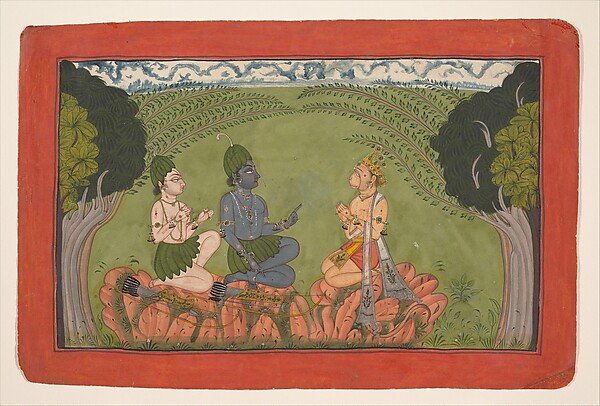
The narrative outline below describes the Valmiki-based tradition represented in the primary reading. Other Ramayana traditions differ in emphasis, characterization, and events. Rama, prince of Ayodhya, is expected to become king. An earlier promise made by his father, Dasharatha, allows Queen Kaikeyi to demand the throne for her son Bharata and fourteen years of exile for Rama. Rama accepts exile to uphold his father's word. Sita and his brother Lakshmana accompany him.
During the forest exile, Ravana, ruler of Lanka, abducts Sita. Rama forms an alliance with Sugriva and the vanaras, among whom Hanuman becomes a central figure. Hanuman locates Sita; an army crosses to Lanka; Rama defeats Ravana; and the exiles return. This broad movement from kingdom to wilderness and back provides a setting for questions about legitimate rule, fidelity, and the cost of fulfilling a duty.
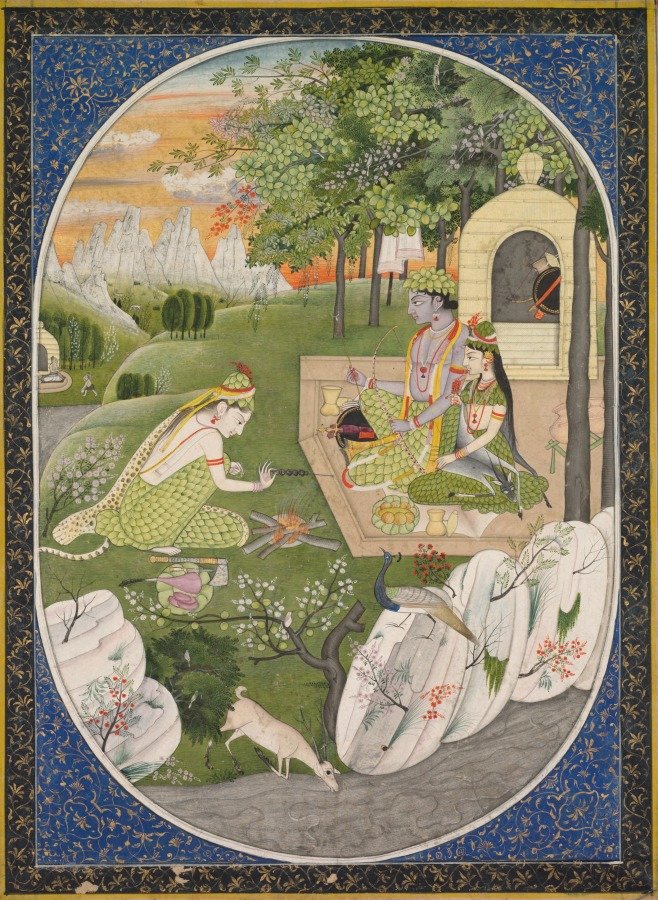
From the palace to the forest and Lanka
Rama's exile begins with a conflict among obligations. Dasharatha must honor the promise he made to Kaikeyi, even though fulfilling it separates him from the son he intended to crown. Rama accepts the demand. Sita insists on sharing his life outside the palace, and Lakshmana accompanies them. Bharata, meanwhile, refuses to treat his mother's success as a reason to celebrate. He seeks Rama's return and, when Rama will not violate the exile, governs in his name, with Rama's sandals serving as a sign of the absent rightful ruler.
The forest contains hermitages, powerful beings and dangerous encounters. Ravana devises a way to separate Sita from her protectors. Maricha takes the form of a golden deer. Rama pursues it at Sita’s request; a cry imitating his voice then draws Lakshmana away.
Ravana approaches Sita in disguise and carries her to Lanka. Jatayu, an aged bird, tries to stop him and is mortally wounded. Rama discovers Sita’s absence and begins to search for her.
Rama allies himself with Sugriva and the vanaras, often represented as monkey-like beings. Hanuman crosses the sea, discovers Sita held in a grove in Lanka, and gives her a sign that he comes from Rama. She remains resistant to Ravana's demands. Hanuman's mission establishes a connection between the separated pair and makes rescue possible. A bridge allows Rama's forces to reach Lanka; the ensuing war culminates in Ravana's defeat.
Recovery does not end every difficulty. In the Valmiki-based narrative, Rama's public response to Sita raises questions about honor, reputation, and the treatment of a woman who has been abducted. Sita enters fire, and Agni bears witness to her purity. The return to Ayodhya and Rama's coronation offer restoration, but later parts of the received epic again confront Sita with public suspicion and separation. These episodes have prompted sharply different devotional, ethical, and literary readings. Retellings can also alter or omit them.
Sita speaks, argues and resists throughout the story. The assigned exchange before exile lets us hear her challenge Rama’s instruction directly. Griffith’s Valmiki-based translation is one telling of a story that survives in many forms. Primary narrative reference: Valmiki's Ramayana, translated by Ralph T. H. Griffith
Sita speaks
The assigned passage pauses before the forest journey. Rama tells Sita to remain behind, describing the hardships ahead. Sita refuses to accept that he alone can define her duty. She argues that their lives belong together and that palace comfort without him would bring no happiness. The exchange is sustained: affection, appeals to duty, fear, anger, and practical preparation all enter the conversation.
Rama’s speech should not automatically be read as the narrator’s judgment. Sita’s reply invokes marital devotion while asserting her right to decide what it requires. Their disagreement remains part of the scene.

Hanuman locates Sita, carries a message and helps Rama’s cause. His actions explain the religious importance of devoted service and the popularity of his image outside a full telling of the epic.
Read closely: Ramayana, Book II, Cantos XXVI–XXX
Underline an argument made by each speaker. Which depends on affection, which on an account of duty, and which on a prediction about danger? Trace the change from Rama's initial instruction to the preparations at the end. Explain what changed without assuming that one isolated line explains the entire exchange.
4.3 The Mahabharata: a family at war
The Mahabharata places rival branches of a ruling family within a world of contested inheritance, vows, humiliation, exile, and war. The Pandavas and Kauravas are cousins. Their conflict draws in elders, teachers, allies, and people whose loyalties cross the division between the armies. The result is an epic in which apparently clear obligations can collide.
The five Pandava brothers include Yudhishthira, Bhima, Arjuna, Nakula, and Sahadeva; Draupadi is their shared wife. Duryodhana is a leading Kaurava figure. A disastrous dice game and Draupadi's humiliation expose the violence that can operate within a royal household and assembly. Exile and failed efforts to resolve the conflict lead toward battle at Kurukshetra. Victory brings immense loss rather than an uncomplicated return to happiness.
The epic repeatedly brings obligations into conflict. A promise can bind someone to an unjust ruler; loyalty to a teacher can obstruct another duty. Characters argue about which obligation has the stronger claim.
The dice hall, exile, and the cost of victory
The Pandavas survive repeated dangers as their rivalry with the Kauravas develops. Arjuna wins Draupadi at a contest, and she becomes the wife of the five brothers. Their establishment of a prosperous kingdom does not settle the quarrel. Duryodhana's resentment and the invitation to a dice game bring the conflict into an assembly where power and apparent legality can be used against the vulnerable.
Yudhishthira, the eldest Pandava, loses wealth, political control, his brothers, himself, and finally Draupadi in the gambling sequence. The claim to have won her raises a question she refuses to let the court ignore: if he had already lost himself, by what authority could he stake her? When she is dragged into the assembly and threatened with disrobing, the silence or helplessness of respected elders becomes part of the scandal. A familiar account describes her clothing becoming inexhaustible under divine protection. Different recensions and retellings handle the episode differently, but her challenge exposes the moral failure of the assembly.
The Pandavas and Draupadi live through exile, including a final period in concealment. Attempts to settle the dispute fail, and armies gather at Kurukshetra.
Arjuna's crisis in the Bhagavad Gita occurs at this point. Teachers and relatives stand among those he is expected to fight. Krishna's instruction takes place within a war whose causes the reader already knows; the conversation cannot be separated entirely from the injuries, loyalties, and failed judgments that brought the families there.
The battle destroys much of the world the warriors sought to govern. Bhishma and Drona, revered elders and teachers, die. Karna, whose connections with the Pandavas complicate the division into opposing sides, is also killed. Strategies that secure victory raise questions about the relationship between a just cause and the methods used in its service. Later violence against surviving family members makes the aftermath still more devastating.
Victory leaves Yudhishthira grieving for the people killed. The epic continues through his rule, renunciation and the brothers’ final journey. Dutt’s condensed translation provides one account of this larger narrative. Primary narrative reference: Romesh Dutt's public-domain condensed verse rendering of the Mahabharata
| Question | Ramayana selection | Mahabharata / Gita selection |
|---|---|---|
| Immediate crisis | Rama must leave for exile; Sita insists on accompanying him. | Arjuna recognizes relatives and teachers in the opposing army. |
| Competing claims | A father's word, marital loyalty, safety, and personal choice. | Warrior duty, affection, social order, and responsibility for killing. |
| Form of reflection | A sustained exchange between spouses. | A dialogue between a distressed warrior and Krishna. |
4.4 The Bhagavad Gita: acting in a troubled world
Cristian Violatti, “Bhagavad Gita,” via ATD World Religions; parallel text in the Reno edition. CC BY-NC-SA 3.0.
The name Bhagavad Gita means “ the song of the Lord ”. It is composed as a poem and it contains many key topics related to the Indian intellectual and spiritual tradition. Although it is normally edited as an independent text, the Bhagavad Gita became a section of a massive Indian epic named “The Mahabharata,” the longest Indian epic. There is a part in the middle of this long text, consisting of 18 brief chapters and about 700 verses: this is the section known as the Bhagavad Gita. It is also referred to as the Gita , for short.
Cristian Violatti, Bhagavad Gita, Ancient History Encyclopedia, reproduced in ATD World Religions; attribution key (8). Parallel online edition: University of Nevada, Reno, World Religions, Sacred Text. Source. CC BY-NC-SA 3.0.
The plot of the Gita is based on two sets of cousins competing for the throne: The Pandavas and the Kauravas .
Diplomacy has failed, so these two clans’ armies meet on a battlefield in order to settle the conflict and decide which side will gain the throne. This is a major battle and it takes place in Kurukshetra, “the field of the Kurus,” in the modern state of Haryana in India.
Arjuna , the great archer and leader of the Pandavas, is a member of the Kshatriyas caste (the warrior rulers caste). He looks out towards his opponents and recognizes friends, relatives, former teachers, and finally realizes that controlling the kingdom is not worth the blood of all his loved ones. Emotionally overwhelmed, Arjuna drops down, casts aside his bow and arrows, and decides to quit. He prefers to withdraw from battle; he prefers inaction instead of being responsible for the death of the people he loves.
His chariot driver is the god Vishnu, who has taken the form of Krishna. Krishna sees Arjuna quitting and begins to persuade Arjuna that he should stick to his duty as a warrior and engage the enemy.
The Bhagavad Gita is presented as a conversation between Arjuna and Krishna, a man and a god, a seeker and a knower. (8)
Arjuna recognizes relatives and teachers across the battlefield. Chapter I describes his physical distress and his argument that killing them would destroy the relationships and duties the war is supposed to defend.
Cristian Violatti, Bhagavad Gita, Ancient History Encyclopedia, reproduced in ATD World Religions; attribution key (8). Source. CC BY-NC-SA 3.0.
The Bhagavad Gita revolves around the following questions:
How can someone live a life spiritually meaningful without withdrawing from society?
What can someone who does not want to give up family and social obligations do to live the right way?
In Chapter III, Krishna argues that refusing to act does not by itself bring freedom. He describes disciplined action without possessiveness and connects sacrifice with the maintenance of the world.
Chapter IX develops devotion through acts dedicated to Krishna, including a modest offering made with love. Chapter XII describes a devotee’s conduct toward other beings and responses to praise, blame, success and failure.
Krishna’s answers concern knowledge, motives, attachment, devotion and the welfare of others. The battlefield setting keeps the cost of Arjuna’s decision in view. Different interpreters have drawn different conclusions about the teaching’s relation to warfare.
4.5 When an epic becomes a performance
Epic knowledge can be acquired by watching and listening as well as by reading. Ramlila dramatizes the Rama story through scenes that combine narration, dialogue, song, and recitation. UNESCO's account describes performances across northern India during Dussehra and their relationship to Tulsidas's Ramcharitmanas. The Sanskrit text, a later vernacular devotional work, and a community performance belong to related but distinct settings. Source: UNESCO, Ramlila.
In Ramlila, familiar speeches and scenes return each year through actors, music and public performance. An audience may know what will happen and still gather for a particular moment, such as Rama’s return or Ravana’s defeat.
4.6 Puja: presence, hospitality, and offering

Julius Lipner / British Library, “Hindu Deities,” via Smarthistory, CC BY-NC-SA 4.0.
By the first centuries of the Common Era, cults of the worship of images of various deities, such as Vishnu and the Goddess, were established. Such worship ( pūjā ) would have taken place both at home and in the temple. In time, temple design became ornate and varied, and temple-worship involved making the image according to strict iconographic rules and served by a dedicated class of priests, an elaborate ritual of consecration of the image, flower and food offerings, anointing and bathing the image, oil lamps, incense, bells and processions with the image, a daily programme for the deities involved patterned on practices of the royal court, and so on.
Julius Lipner, British Library, Hindu Deities, reproduced by Jody L Ondich; open republication at Smarthistory, whose FAQ specifies CC BY-NC-SA 4.0. Source. CC BY-NC-SA 4.0.
Other than by forms of temple worship, which include both personal prayer and various rituals conducted by priests, the deity may be worshipped at home too, in a format called puja. In its simplest form, puja usually consists of making an offering of flowers or fruit to an image of a god at a home shrine. It can also happen by way of meditation ( dhyāna ). Dhyāna can include highly specialized kinds of visualization of the deity invoked, in which the deity is often envisaged as communicating with the worshipper.
Puja can be understood through the honoring of a divine guest or presence. Its forms vary in scale and sequence. An image may be welcomed, bathed, clothed, adorned, and offered fragrance, flowers, food, and light. A household observance can be brief; temple worship may involve specialist priests and an elaborate daily schedule. The source's examples describe possibilities, not a requirement that every participant perform every act.
Darshan is the auspicious encounter of seeing the deity and being seen. Arati offers light before the divine image. Prasada is the blessed gift received after an offering, often food shared among devotees. Source: Hindu American Foundation, puja guide
A mantra is a sacred utterance or formula, often recited repeatedly. Devotional songs, or bhajans, and congregational singing such as kirtan give sound a communal form. Fire offerings, often called homa or yajna in particular settings, are another important ritual form. Do not use sacrifice as if it always meant killing an animal: offerings into a fire may include clarified butter, grains, and other substances. See HAF's account of devotional expression and Yale's introduction to Vedic sacred words.
Observe a ritual as a relationship
Describe who offers, to whom, through what words and gestures, and what is received or shared. Attend to sound, smell, food, movement, and light. Then ask how participants explain the actions. An observer's sensory description and a devotee's account of divine presence answer different questions; a careful study needs room for both.
4.7 Ritual across a lifetime
Ritual also marks changes in a person's relationships. Samskaras are rites associated with important transitions, including birth, naming, education or initiation in some communities, marriage, and death. Their number, eligibility, sequence, and performance vary. A prescriptive list in a Sanskrit text is evidence of an ideal or rule, not proof that every family followed it.
Marriage ceremonies can include a sacred fire, offerings, vows, and steps that make a new household publicly recognizable. Funeral and ancestral rites place death within continuing obligations to relatives and ancestors. Cremation is common in many Hindu communities but should not be presented as an exceptionless rule. Regional practice, family tradition, religious affiliation, and circumstances matter. Further orientation: Pluralism Project, Hindu traditions and religious life.
Death, ancestors, and disciplined life
Cremation, the handling of ashes and later offerings connect a death with responsibilities of surviving relatives. The Ganga and other sacred places can be important to these rites. Some communities, and some categories of deceased people, use burial or other arrangements.
Yoga likewise extends beyond a set of physical postures. Paths of action, knowledge, devotion, and meditative discipline organize different relationships between everyday activity and liberation. Classical yoga also connects ethical restraints and observances, posture, breath, withdrawal of the senses, concentration, meditation, and deep absorption. In lived settings these practices may overlap with devotion, household responsibilities, or renunciation. A modern exercise class and a renunciant discipline can share some techniques without having identical aims.
Keep samskara distinct from samsara, the cycle of rebirth. Likewise, a life-cycle rite is not the same as the four-ashrama model introduced in Chapter 2. The first marks a transition through ceremony; the second offers an ideal arrangement of stages and responsibilities. Both connect individual lives with communities, but neither supplies a complete description of everyone's biography.
4.8 Pilgrimage and sacred place
Julius Lipner / British Library, “Hindu Deities,” via Smarthistory, CC BY-NC-SA 4.0.
Another form of worshipping the deity in Hinduism is through pilgrimage ( yātrā ). Pilgrimage is a way of creating a sacred landscape, of indicating that the whole world, including the pilgrim, belongs to the deity and is under its rulership. Through every pilgrimage, Hindus encounter a tīrtha , a sacred ford or crossing-point between heaven and earth, by which they may come to terms with this world of sorrows and arrive at the threshold of liberation. Over time, a great many tīrthas have developed across the Hindu sacred landscape.
A tirtha is a crossing place, linking physical geography with spiritual passage. Pilgrims may bathe, make offerings, undertake vows or visit places associated with divine events.
The Ganga is both a river and a goddess for many devotees. Bathing and funerary rites give that understanding a place in everyday religious practice. Accounts of pilgrimage need to attend to those meanings as well as to the conditions of travel and access.
4.9 Festivals and the calendar
Festivals bring worship into household and public life through meals, visits, performances and processions. Participants may emphasize different parts of the occasion.
Many observances follow lunar or lunisolar calculations, with differences among regional calendars. Their dates move in the Gregorian calendar, and local timing can differ. The seasonal descriptions below provide orientation rather than annual dates. Diwali is not always in November, and it does not begin the new year for every Hindu community. Source: Congressional Research Service, Hindu Holidays: Fact Sheet.
| Observance | Typical seasonal setting | Connections to notice |
|---|---|---|
| Diwali / Deepavali | Northern autumn, often October–November | Lamps, auspiciousness, household renewal; different narratives and divine associations. |
| Sharad Navaratri | Northern autumn | Nine nights; Goddess devotion, regional music, dance, and displays. |
| Durga Puja | Associated with the autumn Goddess festival season | Durga, protection, elaborate images and community celebrations. |
| Dussehra / Vijayadashami | The tenth-day culmination following the nine nights | Victory traditions associated with Rama and/or the Goddess in different settings. |
| Holi | Northern spring, usually February–March | Colors, play, Krishna and Radha, and the Holika/Prahlada story in particular traditions. |
| Krishna Janmashtami | Often August–September | Krishna's birth; fasting, night worship, and celebration. |
Editorial comparison checked against the CRS fact sheet, USC's Hindu observance descriptions, and the Pluralism Project festival entries cited below. Southern-hemisphere communities celebrate on the relevant religious dates although local seasons differ. Other important festivals include Maha Shivaratri, Rama Navami, Ganesh Chaturthi, and regionally significant harvest and new-year observances.
4.10 Diwali: lighting the world
Megan Hunt, Congressional Research Service, Hindu Holidays: Fact Sheet, R45001, March 13, 2025, “Diwali.” U.S. government text, public domain; its short quotation is credited below. Official source. Digital copy: EveryCRSReport. Footnote numbers omitted.
Diwali, or Deepavali, is the Hindu festival of lights. It often falls between mid-October and mid-November, and for some observers coincides with the beginning of the New Year. Although the specific celebrations vary by region and group, Diwali is a celebration of the "victory of light over darkness, good over evil, knowledge over ignorance, and hope over despair." It is celebrated over five days and often observed by wearing new clothes, participating in pujas (prayer or worship), exchanging gifts, cleaning the home, lighting oil lamps, participating in festivals, and setting off fireworks.
The report attributes the phrase beginning “victory of light over darkness” to D. Heiligman and V. Narayanan, Celebrate Diwali: With Sweets, Lights and Fireworks (National Geographic, 2008), and its account of practices to R. Rinehart, Contemporary Hinduism: Ritual, Culture, and Practice (2004), pp. 149–150. The brief third-party quotation retains its separate copyright.
The lamps are a recognizable feature, but no single story explains every celebration. Devotion to Lakshmi, the welcoming of auspiciousness into a cleaned and illuminated home, and the return of Rama to Ayodhya are important associations in particular Hindu settings. Kali worship is prominent in some eastern Indian traditions. Avoid substituting one regional account for the whole festival. Source: Pluralism Project, Divali; HAF, Diwali.
Jains and Sikhs also have distinct observances associated with this festival period. Their participation should not be used to relabel them Hindu or to assume that shared lights carry identical meanings. A comparative study asks both what is shared and how each community understands its own occasion.
4.11 Navaratri, Durga Puja, and Dussehra
Navaratri means nine nights. In the autumn observance, devotion to the Goddess takes different forms across regions and communities. Durga Puja is especially important in Bengali traditions; elaborate images and temporary installations can bring art, worship, and community gathering together. Other settings emphasize dance, domestic displays, or forms of the Goddess associated with particular nights. Source: Pluralism Project, Navaratri.
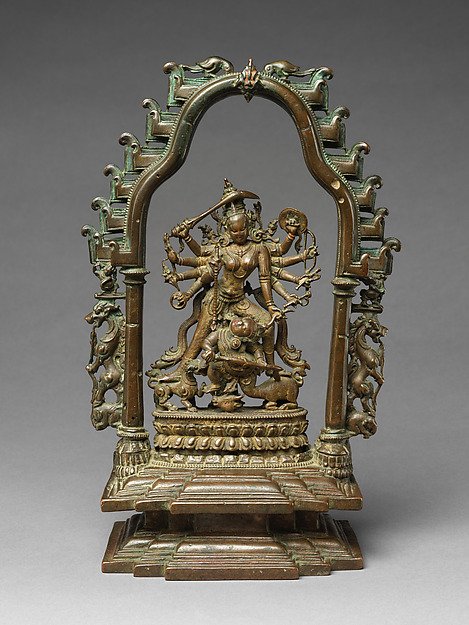
Dussehra, also called Vijayadashami, is the tenth-day culmination. In many northern Indian settings it recalls Rama's defeat of Ravana and is associated with Ramlila and the burning of Ravana effigies. Other settings emphasize the Goddess's victory. These related observances should not be collapsed into a statement that Dussehra itself lasts nine days or that every celebration dramatizes the same narrative. Source: CRS; USC observance descriptions.
4.12 Holi: devotion and play
Holi is a spring festival strongly associated with colored powders and water. Krishna and Radha are important to its devotional worlds in many settings. Traditions concerning Prahlada's devotion to Vishnu and the defeat of Holika are associated with the preceding bonfire. Different communities emphasize different narratives, practices, and lengths of celebration. Source: Pluralism Project, Holi; CoHNA, Holi.
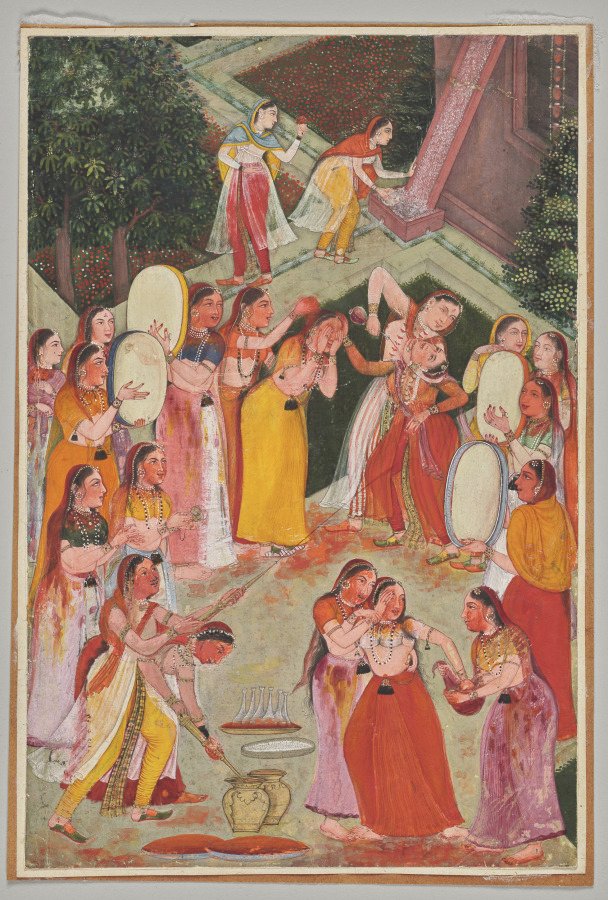
Holi brings play, shared food and public celebration into devotional life. Accounts of temporarily relaxed social boundaries describe the occasion; they do not establish that inequalities disappear afterward.
4.13 Putting the connections together
Review and discussion
- Compare Sita's response to Rama with Arjuna's response to the approaching battle. What makes each an argument rather than a simple expression of emotion?
- Use two passages from Gita III to explain the difference between action and attachment to action's results.
- Read Gita IX beside the puja discussion. How does devotion affect the significance of an offering?
- Choose qualities of a devotee in Gita XII and consider how they complicate a definition of religion based only on public ceremony.
- Explain the relationships among Navaratri, Durga Puja, and Dussehra without treating them as interchangeable names.
- How can one festival carry different narratives and meanings in different communities?
- Choose one image and separate direct visual observation, museum documentation, and religious interpretation.
Key vocabulary
Ramayana; Mahabharata; Bhagavad Gita; dharma; Ramlila; puja; darshan; arati; prasada; mantra; bhajan; kirtan; yajna/homa; samskara; yatra; tirtha; Diwali; Navaratri; Durga Puja; Dussehra; Holi.
A short written assignment
Choose a conflict from an epic passage and a practice from this chapter. Develop a connection using specific evidence from both, then explain a limit of your comparison. Do not assume that the text prescribes the practice or that one participant's experience describes every Hindu.
Primary readings
Read the primary texts for Chapter 4. This separate page contains the assigned passages, translation credits and reading questions.