CA-ROTEL World Religions · Working draft
Chapter 3: Hindu Deities
Divine forms, devotional relationships, and the art of recognizing presence
3.1 Approaching a world of divine forms
A dancer stands within a ring of flames. A child shelters villagers beneath a mountain. A goddess holds a musical instrument. Hindu images identify divine figures through stories, gestures, objects and companions. Learning those details gives us a way to recognize the relationships an image presents.
Julius Lipner, Hindu Deities, British Library, reproduced in World Religions: the Spirit Searching and Huma207. Source edition · CC BY-NC-SA 4.0.
Hinduism can be likened to an enormous banyan tree extending itself through many centers of belief and practice which can be seen to link up with each other in various ways, like a great network that is one, yet many. The concepts of deity, worship and pilgrimage in Hinduism are a prime example of this ‘polycentric’ phenomenon.
The banyan image allows for several related centers of devotion. Vishnu, Shiva or the Goddess may be supreme within a particular tradition; other accounts emphasize ultimate reality beyond form. Household observances and philosophical teaching do not always follow a single scheme.
Polytheism names a plurality of divine beings. It leaves open how those beings are related to one another or to ultimate reality. Monotheism and monism answer different questions, and neither describes every Hindu account of the divine.
3.2 Vedic deities and ultimate reality
Julius Lipner, Hindu Deities, British Library, reproduced in World Religions: the Spirit Searching and Huma207. Source edition · CC BY-NC-SA 4.0.
Deities are a key feature of Hindu sacred texts. The Vedic texts describe many so-called gods and goddesses ( devas and devīs ) who personify various cosmic powers through fire, wind, sun, dawn, darkness, earth and so on. There is no firm evidence that these Vedic deities were worshipped by images; rather, they were summoned through the sacrificial ritual ( yajña ), with the deity Agni (fire) generally acting as intermediary, to bestow various boons to their supplicants on earth in exchange for homage and the ritual offering. Some Vedic texts speak of a One that seemed to undergird the plurality of these devas and devīs as their support and origin. In time, in the Upanishads, this One ( Brahman ) was envisaged as either the transcendent, supra-personal source of all change and differentiation in our world which would eventually dissolve back into the One, or as the supreme, personal Lord who was the mainstay and goal of all finite being. In both conceptions, we have the basis for subsequent notions of a transcendent reality that is accessible to humans by meditation and/or prayer and worship.
Agni, the fire deity, occupies a central place in the primary reader’s opening hymn. Fire receives an offering and carries it toward the gods; the hymn addresses Agni as priest, messenger, and approachable helper. Indra, associated with force and victory, and deities such as Varuna, Mitra, Soma, and Ushas belong to the wider Vedic world. Their prominence in a particular hymn should not be treated as a permanent ranking of every Hindu deity.
The next hymn gives Vāk, Speech, a first-person voice. She claims power working through other gods and human lives. Later Goddess traditions develop related ideas, though this hymn belongs to its own Vedic setting.
Three similar words, different meanings
- Brahman: ultimate reality, understood differently across Hindu philosophical schools.
- Brahma: a personal deity associated with creation, often shown with multiple faces.
- Brahmin: a member of a traditionally priestly social category; the word names a human social identity.
These distinctions help prevent a theological idea, a deity, and a social category from being confused.
3.3 Personal deities and devotional relationships
Devotion to Krishna often uses the language of love. The gopis are cowherd women whose relationships with him become subjects of poetry and worship.
Cristin McKnight Sethi. Representations of Krishna (2021), Smarthistory; reproduced in Huma207, Asia. Source · CC BY-NC-SA 4.0.
Most beloved amongst the gopis is Radha, the consort of Krishna and considered by many devotees to be a goddess in her own right (specifically, an avatar of the goddess Lakshmi). An important early text, the Gita Govinda, composed by the writer Jayadeva in the 12th century, describes in poetic verse the loving, and sometimes contentious, relationship between Krishna and Radha.
Julius Lipner, Hindu Deities, British Library, reproduced in World Religions: the Spirit Searching and Huma207. Source edition · CC BY-NC-SA 4.0.
At about the same time as the Gītā was composed, the Śvetāśvatara Upaniṣad endorses devotion to Shiva (also spelt Śiva), also called Rudra, as the Supreme Being who transforms his devotees from the halter (pāśa) of existence into a state of profound union with him. Both the Gītā and the Śvetāśvatara Upaniṣad proclaim a form of disciplined devotion (bhakti) as the means to salvation, and it was not till about the 5th century that a theology of saving devotion to the Great Goddess (Mahādevī) appeared in the Devī Māhātmya. In a manner that accounts for the devotional faith of most Hindus, each of these three deities, Vishnu (also spelt Viṣṇu), Shiva, and the Goddess, under one alternative name or other, can be seen to head a distinctive strand of theistic Hinduism which inter-relates in complex ways with the other two. In terms of this interlocking grid, most Hindus would have a firm sense of religious belonging through faith in a Supreme Deity who can be approached, understood and worshipped by way of a system of disciplined belief and practice.
Vaishnava, Shaiva and Shakta traditions center respectively on Vishnu, Shiva and the Goddess. Bhakti means devotion. Its language ranges from reverent service to the intimacy of friendship or love, and devotees interpret those relationships through poetry and theology.
An ishtadevata is a chosen or especially cherished deity. A particular name, image and body of stories can sustain that relationship. Chapter 4 examines its expression in worship and festivals.
3.4 Vishnu, avatars, and divine care
Cristin McKnight Sethi. Representations of Krishna (2021), Smarthistory; reproduced in Huma207, Asia. Source · CC BY-NC-SA 4.0.
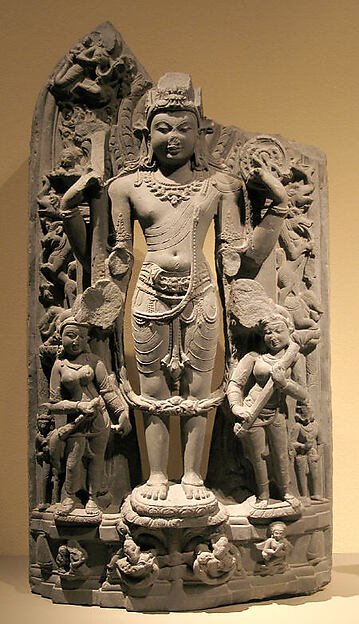
Lord Krishna is an important figure in the Hindu pantheon who appears often in works of art and architecture. Krishna is one of the many avatars (forms or manifestations) of the Hindu god Vishnu, who according to devotees was born on earth to create balance and harmony in the universe. Intense personal devotion (called bhakti) for Krishna continues to be important for many Hindus around the world and is the subject of numerous works of art, from very early representations to the present.
Krishna appears in anthropomorphic (human-like) form, as a male figure with blue-colored skin. He often wears a yellow- or orange-colored hip wrapper and a crown ornamented with peacock feathers. He is powerful, mischievous, fun-loving, flirtatious, and the subject of great adoration. Representations of Krishna appear throughout architecture, paintings, sculpture, and textiles in many parts of the Indian subcontinent. Stories about Krishna are also the subject of numerous important religious texts including the Bhagavata Purana and the Gita Govinda. Krishna also assumes the role of the charioteer for the hero Arjuna in the epic story The Mahabharata, and the conversation about dharma (duty or laws of conduct) that occurs between these two figures during a pause in battle is the foundation for the famous poem the Bhagavad Gita.
Vishnu is associated with sustaining the world and restoring dharma. Many Vaishnava traditions worship him as supreme. A discus, conch, mace and lotus commonly identify his images, though their arrangement varies. Garuda is his animal associate, or vahana. Lakshmi, goddess of prosperity and auspicious well-being, is closely connected with him.

Avatar means a descent or manifestation of the divine in the world. It is especially important in traditions of Vishnu. Familiar avatars include Rama and Krishna, as well as forms such as the fish Matsya, boar Varaha, and man-lion Narasimha. Lists and interpretations vary. Do not use avatar as a blanket explanation for every Hindu deity or confuse it with the ordinary cycle of rebirth introduced in Chapter 2.
In the primary reading, Krishna explains his divine births as a response to the decline of righteousness. He comes to restore dharma. The term avatar concerns such a divine descent, not an ordinary rebirth compelled by karma.
Some traditions worship Krishna as the highest divine reality; others identify him as Vishnu’s avatar. Rama’s association with kingship and duty receives fuller treatment through the Ramayana in Chapter 4.

3.5 Shiva: ascetic, householder, and dancer
Shiva appears as an ascetic, a householder with Parvati and their children, a dancer and a source of liberation. Shaiva traditions worship him as supreme. Destruction belongs to an account of cosmic dissolution and renewal, rather than making him an evil counterpart to other deities.
Common identifying features include a third eye, matted hair, a crescent moon, a trident, and the bull Nandi. Not every image includes every attribute. The linga is another important form through which Shiva is approached; it should not be treated as an incomplete version of a humanlike statue. Human form is one possibility within Hindu sacred representation.

In the familiar Nataraja interpretation, the drum suggests creation, fire suggests dissolution, and the reassuring hand offers freedom from fear. The lifted foot offers a sign of refuge or liberation. These associations help connect visual details to philosophical ideas. Begin with what you can see, then distinguish observation from an interpretation supplied by a tradition or art historian.
3.6 Devi and the many forms of the Goddess
Devi means goddess; Mahadevi means Great Goddess. Shakti is power, particularly divine feminine power. Shakta traditions worship the Goddess as supreme. Nourishing and terrifying forms can belong within the same account of her power.
Parvati is associated with Shiva and their family. Durga confronts forces threatening the gods; Kali’s fierce imagery includes death and destruction. Kali’s devotees also address her as a compassionate mother. The relationship helps explain why a frightening image can be an object of loving devotion.

Lakshmi is associated with prosperity, abundance and auspiciousness. Sarasvati is associated with learning, speech and the arts. A vina, a stringed instrument, and books often identify Sarasvati’s images and connect her with the work of students and musicians.

3.7 Ganesha, Hanuman, and divine relationships
Ganesha is readily recognized by his elephant head and humanlike body. He is associated with beginnings, wisdom, and the placing or removal of obstacles, and is often honored before undertaking a task. His broken tusk, sweets, and mouse companion are familiar attributes, although a particular work may omit them. Narratives of his origins and family vary. His recognizability across many settings does not mean that every Hindu begins every activity in the same way.

Hanuman, the monkey-form devotee associated with Rama, offers another way to think about divine significance. Strength, courage, and devoted service belong together in his portrayal. His role cannot be understood through animal appearance alone; relationships and narrative action matter. Chapter 4 will return to his place in the Ramayana and to the ways stories become models of conduct.
The trimurti groups Brahma, Vishnu and Shiva with creation, preservation and dissolution. It is one arrangement found in Hindu teaching. It does not establish their relative importance in every community and leaves Goddess-centered traditions outside its threefold scheme.
Divine figures in stories
Stories explain many of the details artists use to identify a deity. The accounts below introduce widely told versions; other texts and regional traditions tell them differently.
Ganesha: a guardian becomes the elephant-headed god
In one account, Parvati creates a boy to guard the entrance while she bathes. He refuses to admit Shiva, who does not know who he is. Their confrontation ends with Shiva cutting off the boy’s head. Parvati demands that the child be restored.
An elephant’s head is brought and joined to his body, restoring him to life as Ganesha. Versions differ over who finds the head and how it is obtained. The account explains the elephant-headed figure honored at beginnings and associated with obstacles. Museum account · Parvati and Ganesha in art
Krishna: protection beneath a mountain
Dr. Cristin McKnight Sethi, Representations of Krishna, Smarthistory, July 25, 2021, CC BY-NC-SA 4.0.
The story goes that as a young boy, Krishna noticed the people of Braj spending too much time and energy preparing sacrifices to appease the god Indra, who is the Hindu god of the heavens and also of lightning, storms, and thunder. As a result, the people’s farms and livestock were neglected. Krishna reminded the people of Braj of their duty ( dharma ) to care for their land and animals and suggested instead that they cease the elaborate rituals and sacrifices for Indra. Indra became angered by this and as retribution sent an enormous storm that began to flood the entire region. In response to Indra’s tempest, Krishna lifted up a nearby mountain, Mount Govardhana, and used it as an umbrella to protect the people of Braj.
In the Govardhan story, Krishna’s lifted mountain shelters villagers and animals from the storm. The painting gives visible form to his role as their protector.
Durga: the power that defeats Mahisha
Mahisha, the buffalo demon, overcomes the gods and threatens their order. In a celebrated Goddess narrative, their concentrated powers become manifest in Durga, and they give her their weapons. She confronts an enemy whose changing forms make him difficult to defeat. The image of a goddess with many arms makes visible a power that exceeds the resources of any ordinary warrior.
Durga subdues Mahisha and kills him as he emerges from or is associated with the buffalo form. Artists select a decisive instant from the larger struggle. The weapons in her hands and the beast beneath her feet are therefore narrative clues, not incidental ornaments. The story celebrates protection through the formidable power of the Goddess. The relationship between her independent supremacy and the powers of the other gods is interpreted differently across traditions. Smithsonian, Devi: The Great Goddess; British Museum narrative account.
Chapter 4 returns to Durga’s victory in connection with Durga Puja and the autumn festivals.
Read an image through a story
Choose Ganesha, Krishna, or Durga from the chapter images. Identify two details that a story helps explain, then identify something the image does that a plot summary cannot. Avoid assuming that recognizing an attribute tells you everything about a devotee's relationship with the figure.
3.8 Learning to read a divine image
Julius Lipner, Hindu Deities, British Library, reproduced in World Religions: the Spirit Searching and Huma207. Source edition · CC BY-NC-SA 4.0.
Most deities have an animal associate ( vāhana ) which helps identify the deity and express the latter’s specific powers; this was achieved too by an artistic device that attributed multiple body-parts, such as hands and heads, adorned by weapons and other objects, to the image. There are many stories, especially in the Purāṇas, which describe the origin and role of the vāhana and the weapons and other attributes associated with the image.
Julius Lipner, Hindu Deities, British Library, reproduced in World Religions: the Spirit Searching and Huma207. Source edition · CC BY-NC-SA 4.0.
The temple itself was viewed as the body of the deity, with the darkened chamber at its heart in which (the image of) the deity was placed, known as the garbha-gṛha or ‘womb-house.’ This was the place in which the worshipper, who approached as humble supplicant, was reborn to a new lease of life by the grace of the deity.
Hindus tend to perceive the material of the consecrated image ( arcā ) as having undergone substantial change in the multiple earthly bodies of the deity itself, whose true, transcendent nature is really one and spiritual, consisting of pure consciousness, power and bliss. Here too we see that a complex relationship obtains between the One and the many. This cannot be dubbed ‘idolatry’ in any usually understood, derogatory sense. The point of the transcendent deity’s manifesting as the arcā , of appearing limited and powerless in many forms and places, is to express compassionate love and accessibility ( saulabhya ) on the deity’s part for the sake of the worshipper. Otherwise, as the Viṣṇudharmottara Purāṇa (ca. 6th–7th century) says, ‘what [else] can the image accomplish for the One who is always fulfilled?’ ‘Understand’, continues the Purāṇa, ‘that the purpose of His image-worship is the love of the worshipper’, that is, the divine love for the worshipper and the worshipper’s love for God.
A murti is a divine form or image. Following consecration, an image may be approached as the deity’s presence. Darshan is the auspicious encounter of seeing the deity; devotees also speak of being seen. That encounter belongs to worship, which a museum display cannot reproduce.
The museum works illustrated here come from particular periods and places. Their present display differs from the household shrine, procession or temple for which an image may have been made.
A method for looking closely
- Describe the visible body, pose, faces, arms, gestures, clothing, and objects.
- Look for companions, a vahana, attendants, or a surrounding narrative.
- Identify which details support naming a deity; mark uncertain identifications.
- Consult the object’s place, date, medium, and collection record.
- Explain what an interpretation adds to direct observation. Avoid assuming that one image represents every community’s understanding.
3.9 Bringing the chapter together
Review and discussion
- How does the banyan comparison change the question “How many gods do Hindus have?”
- Explain why Brahman, Brahma, and Brahmin cannot be substituted for one another.
- Compare Agni’s role in the hymn with Krishna’s explanation of divine descent.
- What does the Vāk hymn claim for its speaker? Which lines complicate an easy distinction between one and many?
- Choose two chapter images. Explain three visible differences and their possible religious significance.
- How might an image function differently in a museum and in a consecrated devotional setting?
- Why would calling Durga simply a “goddess of war” or Shiva simply a “destroyer” leave important meanings unexplained?
Key vocabulary
Avatar; bhakti; Brahman; Brahma; Brahmin; darshan; deva/devi; ishtadevata; murti; Shakti; Shaiva; Shakta; Vaishnava; vahana.
Read next: Chapter 3 primary readings: Agni, Vāk, and Krishna. Chapter 4 develops Hindu epics, rituals, and festivals.
Primary readings
Read the primary texts for Chapter 3. This separate page contains the assigned passages, translation credits and reading questions.