Chapter 3: Primary Readings
The complete hymns and complete fourth chapter of the Gita appear below. No external page is required to complete this reading. These historical English translations are public domain in the United States; their vocabulary is part of the translation history, not a contemporary description of every Hindu tradition.
On this page — 4 sections
1. Rig Veda 1.1: Agni
Ralph T. H. Griffith, translator, The Hymns of the Rigveda (1889–1892), Book I, Hymn I, all nine stanzas. Public-domain translation. Digital source.
Notice how the hymn describes Agni as a priest and asks for a relationship of approachability. Hotar names the priest who recites or invokes; weal means well-being. What does the worshipper ask for, and what does the divine intermediary do?
1 I Laud Agni, the chosen Priest, God, minister of sacrifice, The hotar, lavishest of wealth. 2 Worthy is Agni to be praised by living as by ancient seers. He shall bring hitherward the Gods. 3 Through Agni man obtaineth wealth, yea, plenty waxing day by day, Most rich in heroes, glorious. 4 Agni, the perfect sacrifice which thou encompassest about Verily goeth to the Gods. 5 May Agni, sapient-minded Priest, truthful, most gloriously great, The God, come hither with the Gods. 6 Whatever blessing, Agni, thou wilt grant unto thy worshipper, That, Aṅgiras, is indeed thy truth. 7 To thee, dispeller of the night, O Agni, day by day with prayer Bringing thee reverence, we come 8 Ruler of sacrifices, guard of Law eternal, radiant One, Increasing in thine own abode. 9 Be to us easy of approach, even as a father to his son: Agni, be with us for our weal.
2. Rig Veda 10.125: Vāk, Speech
Ralph T. H. Griffith, translator, The Hymns of the Rigveda (1889–1892), Book X, Hymn CXXV, all eight stanzas. Public-domain translation. Digital source.
Vāk is the hymn’s speaking divine voice. Identify the movement between named deities, ordinary bodily life, power, and the cosmos. Does speaking alongside other gods limit her claim, or does it help express it? “Brahman” in stanza 5 refers to a priestly person in this translation; it should not automatically be read as the philosophical term for ultimate reality.
1 I TRAVEL with the Rudras and the Vasus, with the Ādityas and All-Gods I wander. I hold aloft both Varuṇa and Mitra, Indra and Agni, and the Pair of Aśvins. 2 I cherish and sustain high-swelling Soma, and Tvaṣṭar I support, Pūṣan, and Bhaga. I load with wealth the zealous sacrificer who pours the juice and offers his oblation 3 I am the Queen, the gatherer-up of treasures, most thoughtful, first of those who merit worship. Thus Gods have stablished me in many places with many homes to enter and abide in. 4 Through me alone all eat the food that feeds them,—each man who sees, breathes, hears the word outspoken They know it not, but yet they dwell beside me. Hear, one and all, the truth as I declare it. 5 I, verily, myself announce and utter the word that Gods and men alike shall welcome. I make the man I love exceeding mighty, make him a sage, a Ṛṣi, and a Brahman. 6 I bend the bow for Rudra that his arrow may strike and slay the hater of devotion. I rouse and order battle for the people, and I have penetrated Earth and Heaven. 7 On the world's summit I bring forth the Father: my home is in the waters, in the ocean. Thence I extend o’er all existing creatures, and touch even yonder heaven with my forehead. 8 I breathe a strong breath like the wind and tempest, the while I hold together all existence. Beyond this wide earth and beyond the heavens I have become so mighty in my grandeur.
Textual note: three evident digital transcription errors are corrected: “sdcrificer” to “sacrificer,” “brewhes” to “breathes,” and numeral “1,” at the beginning of stanza 5 to “I,”. Line breaks are arranged by stanza; historical wording is otherwise retained.
3. Bhagavad Gita, Chapter IV: Krishna’s divine births
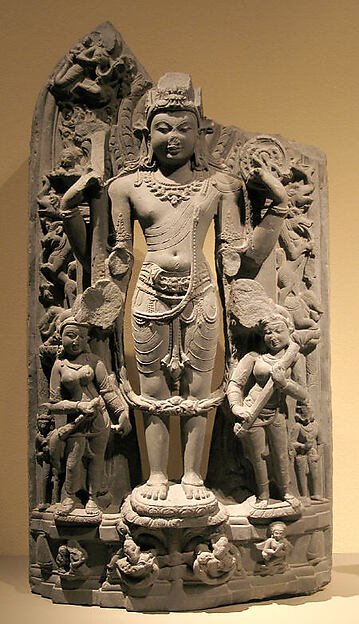
Sir Edwin Arnold, translator, The Song Celestial; or, Bhagavad-Gîtâ (first published 1885), Chapter IV, complete poetic text. Project Gutenberg, eBook 2388, public domain in the USA. Translator footnote markers are omitted.
Krishna answers Arjuna’s question about how he could have taught in an earlier age. Compare the speaker’s knowledge of his births with Arjuna’s, and connect his reason for taking visible form with the chapter’s discussion of avatars. “Bharata” addresses Arjuna through his ancestry.
In this chapter, Krishna connects divine descent with knowledge and action. Arnold uses “Brahm” and sometimes “Brahma” for ultimate reality; these usages should be distinguished from the personal deity Brahma. Ghee is clarified butter used in offerings. The discussion moves between offerings into fire and other forms of discipline, including restraint, study and giving. The translation also preserves claims about caste and rebirth that deserve close reading.
Krishna.
This deathless Yoga, this deep union,
I taught Vivaswata, the Lord of Light;
Vivaswata to Manu gave it; he
To Ikshwaku; so passed it down the line
Of all my royal Rishis. Then, with years,
The truth grew dim and perished, noble Prince!
Now once again to thee it is declared--
This ancient lore, this mystery supreme--
Seeing I find thee votary and friend.
Arjuna.
Thy birth, dear Lord, was in these later days,
And bright Vivaswata's preceded time!
How shall I comprehend this thing thou sayest,
"From the beginning it was I who taught?"
Krishna.
Manifold the renewals of my birth
Have been, Arjuna! and of thy births, too!
But mine I know, and thine thou knowest not,
O Slayer of thy Foes! Albeit I be
Unborn, undying, indestructible,
The Lord of all things living; not the less--
By Maya, by my magic which I stamp
On floating Nature-forms, the primal vast--
I come, and go, and come. When Righteousness
Declines, O Bharata! when Wickedness
Is strong, I rise, from age to age, and take
Visible shape, and move a man with men,
Succouring the good, thrusting the evil back,
And setting Virtue on her seat again.
Who knows the truth touching my births on earth
And my divine work, when he quits the flesh
Puts on its load no more, falls no more down
To earthly birth: to Me he comes, dear Prince!
Many there be who come! from fear set free,
From anger, from desire; keeping their hearts
Fixed upon me--my Faithful--purified
By sacred flame of Knowledge. Such as these
Mix with my being. Whoso worship me,
Them I exalt; but all men everywhere
Shall fall into my path; albeit, those souls
Which seek reward for works, make sacrifice
Now, to the lower gods. I say to thee
Here have they their reward. But I am He
Made the Four Castes, and portioned them a place
After their qualities and gifts. Yea, I
Created, the Reposeful; I that live
Immortally, made all those mortal births:
For works soil not my essence, being works
Wrought uninvolved. Who knows me acting thus
Unchained by action, action binds not him;
And, so perceiving, all those saints of old
Worked, seeking for deliverance. Work thou
As, in the days gone by, thy fathers did.
Thou sayst, perplexed, It hath been asked before
By singers and by sages, "What is act,
And what inaction? "I will teach thee this,
And, knowing, thou shalt learn which work doth save
Needs must one rightly meditate those three--
Doing,--not doing,--and undoing. Here
Thorny and dark the path is! He who sees
How action may be rest, rest action--he
Is wisest 'mid his kind; he hath the truth!
He doeth well, acting or resting. Freed
In all his works from prickings of desire,
Burned clean in act by the white fire of truth,
The wise call that man wise; and such an one,
Renouncing fruit of deeds, always content.
Always self-satisfying, if he works,
Doth nothing that shall stain his separate soul,
Which--quit of fear and hope--subduing self--
Rejecting outward impulse--yielding up
To body's need nothing save body, dwells
Sinless amid all sin, with equal calm
Taking what may befall, by grief unmoved,
Unmoved by joy, unenvyingly; the same
In good and evil fortunes; nowise bound
By bond of deeds. Nay, but of such an one,
Whose crave is gone, whose soul is liberate,
Whose heart is set on truth--of such an one
What work he does is work of sacrifice,
Which passeth purely into ash and smoke
Consumed upon the altar! All's then God!
The sacrifice is Brahm, the ghee and grain
Are Brahm, the fire is Brahm, the flesh it eats
Is Brahm, and unto Brahm attaineth he
Who, in such office, meditates on Brahm.
Some votaries there be who serve the gods
With flesh and altar-smoke; but other some
Who, lighting subtler fires, make purer rite
With will of worship. Of the which be they
Who, in white flame of continence, consume
Joys of the sense, delights of eye and ear,
Forgoing tender speech and sound of song:
And they who, kindling fires with torch of Truth,
Burn on a hidden altar-stone the bliss
Of youth and love, renouncing happiness:
And they who lay for offering there their wealth,
Their penance, meditation, piety,
Their steadfast reading of the scrolls, their lore
Painfully gained with long austerities:
And they who, making silent sacrifice,
Draw in their breath to feed the flame of thought,
And breathe it forth to waft the heart on high,
Governing the ventage of each entering air
Lest one sigh pass which helpeth not the soul:
And they who, day by day denying needs,
Lay life itself upon the altar-flame,
Burning the body wan. Lo! all these keep
The rite of offering, as if they slew
Victims; and all thereby efface much sin.
Yea! and who feed on the immortal food
Left of such sacrifice, to Brahma pass,
To The Unending. But for him that makes
No sacrifice, he hath nor part nor lot
Even in the present world. How should he share
Another, O thou Glory of thy Line?
In sight of Brahma all these offerings
Are spread and are accepted! Comprehend
That all proceed by act; for knowing this,
Thou shalt be quit of doubt. The sacrifice
Which Knowledge pays is better than great gifts
Offered by wealth, since gifts' worth--O my Prince!
Lies in the mind which gives, the will that serves:
And these are gained by reverence, by strong search,
By humble heed of those who see the Truth
And teach it. Knowing Truth, thy heart no more
Will ache with error, for the Truth shall show
All things subdued to thee, as thou to Me.
Moreover, Son of Pandu! wert thou worst
Of all wrong-doers, this fair ship of Truth
Should bear thee safe and dry across the sea
Of thy transgressions. As the kindled flame
Feeds on the fuel till it sinks to ash,
So unto ash, Arjuna! unto nought
The flame of Knowledge wastes works' dross away!
There is no purifier like thereto
In all this world, and he who seeketh it
Shall find it--being grown perfect--in himself.
Believing, he receives it when the soul
Masters itself, and cleaves to Truth, and comes--
Possessing knowledge--to the higher peace,
The uttermost repose. But those untaught,
And those without full faith, and those who fear
Are shent; no peace is here or other where,
No hope, nor happiness for whoso doubts.
He that, being self-contained, hath vanquished doubt,
Disparting self from service, soul from works,
Enlightened and emancipate, my Prince!
Works fetter him no more! Cut then atwain
With sword of wisdom, Son of Bharata!
This doubt that binds thy heart-beats! cleave the bond
Born of thy ignorance! Be bold and wise!
Give thyself to the field with me! Arise!
HERE ENDETH CHAPTER IV. OF THE BHAGAVAD-GITA,
Entitled "Jnana Yog,"
Or "The Book of the Religion of Knowledge,"
Reading across the selections
- Compare Agni’s role as an intermediary with Vāk’s claims to sustain other divine beings.
- How does the image of a father in the Agni hymn differ from Krishna’s explanation of divine action?
- Find one protective and one forceful image in these readings. Why would either alone be an incomplete account of divine power?
- Choose a chapter image and explain one connection to a passage. State whether the connection is historical evidence or your own comparison.