CA-ROTEL World Religions
Chapter 13: Islam: Origins, Beliefs and Practices
On this page — 14 sections
- 1. Islam, Muslims and the worship of one God
- 2. Arabia and the setting of Muhammad’s life
- 3. Revelation and the message in Mecca
- 4. The Hijra and the community in Medina
- 5. The Qur’an: a recited and written scripture
- 6. Belief in God, guidance and judgment
- 7. Muhammad’s example and the hadith
- 8. The Five Pillars: faith put into practice
- 9. Giving, fasting and shared time
- 10. Hajj, Abraham and the sacred landscape
- 11. Ethics, food, family and the end of life
- 12. A short chronology
- 13. Primary readings and questions
- Primary readings
1. Islam, Muslims and the worship of one God
John Mack, in Tim McKenzie, ed.. World Religions, Islam. Source · CC BY-NC-SA 4.0.
The term “Islam” itself is derived from the Arabic word for “submission” or “surrender,” reflecting the faith’s emphasis on surrendering to the will of God and living a life of obedience to His commands. Those who follow Islam are known as Muslims, and they come from diverse backgrounds and cultures, united by their shared beliefs and practices. Muslims can be found in nearly every corner of the world, and their shared faith transcends cultural, linguistic, and geographical boundaries.
Allah is Arabic for God, not the name of a separate deity worshipped only by Muslims. Arabic-speaking Christians also use the word. Muslims understand themselves to worship the God of Abraham, Moses and Jesus, while disagreeing with Christian teachings about incarnation and Trinity. Tawhid, the oneness of God, shapes belief, prayer and conduct. Muhammad is honored as God’s messenger, not worshipped as God.
Ann Kordas, Ryan J. Lynch, Brooke Nelson and Julie Tatlock / OpenStax. World History, Volume 1, §11-1 The Rise and Message of Islam. Source · CC BY-NC-SA 4.0.
While the conflict between the Byzantines and the Sasanians raged at the beginning of the seventh century, western Arabia began to take center stage in the creation of a new world religion deeply influenced by the environment, people, and cultures of the late antique Middle East. That religion was Islam, a word meaning “submission [to the one God].” Islam is a monotheistic faith that shares many features with both Judaism and Christianity, while at the same time having many features that were uniquely Arabian and that eventually brought the culture and traditions of the Arabian Peninsula to greater prominence.
Historical study dates the emergence of the Muslim community to seventh-century Arabia. Muslim religious accounts place Muhammad within a longer history of divine guidance, recognizing Adam, Noah, Abraham, Moses and Jesus among earlier prophets. His mission is understood as restoring and confirming worship of one God.
Islam is a worldwide religion. Its believers speak many languages, belong to many ethnic groups and live as both majorities and minorities. The Arab setting of the Qur’an remains important, but “Muslim” and “Arab” are not interchangeable terms. Nor does a shared religious identity tell us everything about a person’s education, politics, occupation or degree of observance.
2. Arabia and the setting of Muhammad’s life
Ann Kordas, Ryan J. Lynch, Brooke Nelson and Julie Tatlock / OpenStax. World History, Volume 1, §11-1 The Rise and Message of Islam. Source · CC BY-NC-SA 4.0.
Muslim tradition tells us that Muhammad was a merchant from a prominent Arab tribe called Quraysh in the Hijaz region. Born in the city of Mecca, he spent his early life engaged in the trade that passed along the north–south trade routes through his city, a hub that had become a waystation and a good place to conduct business. The tribe of Quraysh dominated leadership and trade in the region in large part because its members were the protectors of the sacred Kaaba, which in this period, we are told, had become a house of idol worship, a center of polytheism among the Arabs. Long-distance trade of luxury goods could be risky because of raiding that occurred along trade routes, and the Kaaba had become a sanctuary where fighting was illicit, making it a safe place to conduct business. The Quraysh were enriched as the stewards of this important sanctuary and had a keen interest in protecting its role in society.
Mecca lay in the Hijaz in western Arabia. Kinship organized protection, trade and conflict. Towns, farming settlements and Jewish and Christian communities connected Arabia to neighboring societies. The Byzantine and Sasanian empires to the north had fought a long war in the early seventh century.
Muslim tradition dates Muhammad’s birth to about 570 CE. Orphaned as a child, he lived under the care of relatives, including his grandfather and then his uncle Abu Talib. He became involved in trade and married Khadija, an established merchant. Stories about his early life come primarily through later Muslim biographical traditions. Historians study those sources alongside the Qur’an, inscriptions and other evidence, distinguishing the tradition’s testimony from details that can be independently established.
Ann Kordas, Ryan J. Lynch, Brooke Nelson and Julie Tatlock / OpenStax. World History, Volume 1, §11-1 The Rise and Message of Islam. Source · CC BY-NC-SA 4.0.
There has been much disagreement throughout history over who was the first man to convert to Islam after hearing Muhammad’s message, but there is no debate among Muslim sources about who was the first person to do so: his first wife Khadija. As a successful merchant in her own right—who had lifted Muhammad’s standing in their community by marrying him and bringing him into her caravan business—Khadija too would have had much to lose in supporting the new religion.
Khadija’s importance is more than a detail in a famous man’s biography. In Muslim accounts she recognizes the significance of Muhammad’s experience, comforts him and supports the new community. Other early followers included Ali, Abu Bakr and people without strong social protection. Their different relationships to Muhammad would become important in later memories of the community’s beginnings.
3. Revelation and the message in Mecca
Ann Kordas, Ryan J. Lynch, Brooke Nelson and Julie Tatlock / OpenStax. World History, Volume 1, §11-1 The Rise and Message of Islam. Source · CC BY-NC-SA 4.0.
According to Muslim belief, in the year 610 the middle-aged Muhammad, who had traveled to a cave just outside Mecca for contemplation, received contact from God through the intermediary of the angel Gabriel (Jabrīl in Arabic). Muhammad was told to recite the first revelations of a scripture that became the Muslim holy book, the Quran.
The encounter is traditionally located in the cave of Hira near Mecca. Muhammad receives the command to recite; Qur’an 96:1–5 is commonly identified with the first revelation. Muslim tradition holds that revelations continued until his death in 632. The word Qur’an is associated with recitation, and the text’s spoken and heard character remains central to Muslim life.
Marmaduke Pickthall, translator (1930); digital text: AlQuran Cloud, en.pickthall. The Meaning of the Glorious Koran. Source · Historical translation public domain in the United States (1930 publication; as of 2026).
96:1 Read: In the name of thy Lord Who createth,
96:2 Createth man from a clot.
96:3 Read: And thy Lord is the Most Bounteous,
96:4 Who teacheth by the pen,
96:5 Teacheth man that which he knew not.
John Mack, in Tim McKenzie, ed.. World Religions, Islam. Source · CC BY-NC-SA 4.0.
After the first revelations, Muhammad began a life of preaching in Mecca. The verses of the Qur’an that he received during this time emphasized the oneness of God, which is the central tenet of the Islamic faith. Muhammad preached this idea to the people of Mecca, and also taught about morality, social justice for the poor and downtrodden, and the inevitability of the Day of Judgment.
The message joined worship to moral responsibility. Wealth did not free a person from obligations to neighbors, orphans or the poor. Human beings would answer to God for their conduct. Qur’an 107, included in the reader, connects rejection of judgment with pushing away the orphan, neglecting the needy and making prayer an empty display. This helps explain why a chapter about belief also has to discuss economic and social relationships.
Ann Kordas, Ryan J. Lynch, Brooke Nelson and Julie Tatlock / OpenStax. World History, Volume 1, §11-1 The Rise and Message of Islam. Source · CC BY-NC-SA 4.0.
While many of Muhammad’s confidants and family members embraced Islam shortly after the revelations began and continued, his career as a prophet, especially the first twelve years, was fraught with challenge. His preaching of monotheism upset the political status quo and was often resisted. The support of his family, especially his wives, was critical to his success as a preacher, and the guidance of Khadija was especially significant. Tradition suggests that when Muhammad thought he might be mad as the revelations first came to him, it was she who convinced him to trust and embrace his new calling.
The new teaching challenged the religious practices and social standing of Mecca’s leaders. Some followers experienced severe persecution. In Muslim accounts, the death of Khadija and of Muhammad’s protector Abu Talib in about 619 made his situation more precarious. Conversion did not immediately bring political success or security.
Ann Kordas, Ryan J. Lynch, Brooke Nelson and Julie Tatlock / OpenStax. World History, Volume 1, §11-1 The Rise and Message of Islam. Source · CC BY-NC-SA 4.0.
Even before fleeing Mecca, some from Muhammad’s community sought refuge and support wherever they could find it as they attempted to expose more of the region to the monotheistic message of Islam. One support was found across the Red Sea, in East Africa in the Christian Kingdom of Aksum. There, the Negus—the leader of Aksum in what is modern-day Ethiopia—provided shelter for Muslims fleeing Meccan persecution and allowed them to practice their faith under his protection. Many remained there until they were able to return to Muhammad and emigrate to Medina, too. This support from the Aksumites was important to the survival of Islam, and in fact the decision by some early Muslims to seek refuge in Ethiopia is sometimes referred to as “the first hijra.”
The Night Journey and Ascension also occupy an important place in Muslim memory. Qur’an 17:1 describes a journey from the Sacred Mosque to the Farthest Mosque; later traditions connect it to Jerusalem and describe Muhammad’s ascent through the heavens, encounters with earlier prophets and the obligation of daily prayer. The Dome of the Rock and the al-Aqsa Mosque are distinct buildings within the sacred precinct in Jerusalem. The site’s Muslim significance should not be reduced to modern political conflict, though that conflict affects access and public understanding.
4. The Hijra and the community in Medina
Ann Kordas, Ryan J. Lynch, Brooke Nelson and Julie Tatlock / OpenStax. World History, Volume 1, §11-1 The Rise and Message of Islam. Source · CC BY-NC-SA 4.0.
In 622, Muhammad’s twelfth year of prophecy, his community fled persecution and increasing aggression by the polytheist Meccans. They were invited to join another community of Arabs in a city called Yathrib, later known as Medina, “the city” or more specifically “the prophet’s city.” There they were welcomed among other Arab tribes, including some practicing Judaism. This hijra, meaning “emigration,” was a watershed moment for Muhammad’s early community. At a low ebb and without any certainty of survival, Islam now changed from a small religion mostly confined to Mecca to a larger community united by Muhammad that solidified its place in world history. The hijra holds such importance in the history of Islam that the Islamic lunar calendar counts 622 CE as its first year. (Dates in the Muslim calendar, used by many around the world today, are often labeled in English with AH, for “After the Hijra.”)
Ann Kordas, Ryan J. Lynch, Brooke Nelson and Julie Tatlock / OpenStax. World History, Volume 1, §11-1 The Rise and Message of Islam. Source · CC BY-NC-SA 4.0.
In Medina, the previously polytheist Arabs, Jewish Arabs, and Muhammad’s ummah formed an alliance for their common defense. Muhammad served first as an arbiter of disputes between the tribes and, soon after, as the city’s de facto leader.
Umma means community. In Medina, Muhammad’s responsibilities included judging disputes, negotiating alliances and organizing defense. Revelations addressed household and communal obligations in that setting. The document called the Constitution of Medina preserves an account of mutual responsibilities, although its composition and precise history are debated.
Relations in Medina included cooperation and grave conflict. Muslim accounts describe disputes with Jewish tribes and severe punishments during the wars. These episodes need historical examination in their particular settings; they do not justify treating all Jews and Muslims as timeless enemies. The Qur’an itself contains both arguments with other religious communities and recognition of their place in the history of revelation.
Battles with Meccan forces included Badr in 624, Uhud in 625 and the siege often called the Battle of the Trench in 627. The treaty of Hudaybiyya in 628 created a period of truce. In 630 Muhammad’s forces entered Mecca, and Muslim tradition describes the removal of idols from the Kaaba. Mecca’s sanctuary became a focus of monotheistic worship. Muhammad continued to live in Medina and died there in 632. Chapter 14 follows the contested question of leadership after his death.
Ann Kordas, Ryan J. Lynch, Brooke Nelson and Julie Tatlock / OpenStax. World History, Volume 1, §11-1 The Rise and Message of Islam. Source · CC BY-NC-SA 4.0.
Muhammad had succeeded in uniting the majority of Arab tribes of western Arabia under his leadership. He spent the next two years continuing to expand his community and spreading the message of Islam, until his death from natural causes in the year 632.
5. The Qur’an: a recited and written scripture
Wikipedia for Schools, Islam; ATD attribution (45). World Religions, Articles of Faith. Source · CC BY-SA 3.0.
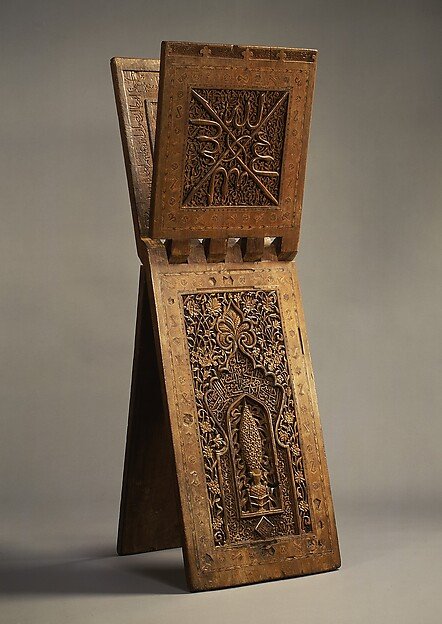
The Qur’an is divided into 114 suras, or chapters, which combined, contain 6,236 āyāt, or verses. The chronologically earlier suras, revealed at Mecca, are primarily concerned with ethical and spiritual topics. The later Medinan suras mostly discuss social and moral issues relevant to the Muslim community. The Qur’an is more concerned with moral guidance than legal instruction, and is considered the “sourcebook of Islamic principles and values.” Muslim jurists consult the hadith, or the written record of Prophet Muhammad’s life, to both supplement the Qur’an and assist with its interpretation. The science of Qur’anic commentary and exegesis is known as tafsir. Rules governing proper pronunciation are called tajwid.
A sura is a chapter and an aya a verse or sign. The chapters are not arranged as a continuous biography or a chronological account of Muhammad’s life. They include praise, warning, stories of prophets, arguments, images of judgment and instructions for conduct. After the opening chapter, longer suras tend to appear earlier, although this is not an exact rule. The conventional division into Meccan and Medinan revelation concerns periods in Muhammad’s mission; a sura may also include material associated with different occasions.
Muslim accounts describe revelation being memorized and written during Muhammad’s lifetime, gathered after his death, and standardized under the caliph Uthman in the mid-seventh century. This process belongs to the history of transmission, not to a claim that Muhammad wrote a book in the manner of a modern author. Recognized readings, or qira’at, preserve authorized variations in recitation; these should not be confused with entirely different Muslim Bibles.
Wikipedia for Schools, Islam; ATD attribution (45). World Religions, Articles of Faith. Source · CC BY-SA 3.0.
Muslims usually view “the Qur’an” as the original scripture as revealed in Arabic and that any translations are necessarily deficient, which are regarded only as commentaries on the Qur’an.
English translations make choices among possible meanings. The primary reader uses Pickthall’s 1930 rendering. Its older English and parenthetical explanations are retained; words in parentheses belong to the translator’s presentation.
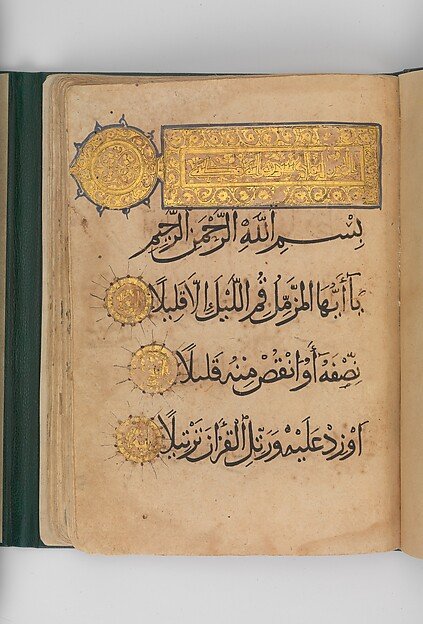
A person who has memorized the Qur’an is often called a hafiz. Recitation can be studied with a teacher and heard in prayer, at home or through recorded media. Tajwid concerns proper recitation; tafsir is interpretation or commentary. Respect for the physical text can be expressed through careful handling, cleanliness and placement. Practices vary, but the central place of sound helps explain why a silent English excerpt gives only one part of a student’s encounter with the Qur’an.
6. Belief in God, guidance and judgment
Wikipedia for Schools, Islam; ATD attribution (45). World Religions, Articles of Faith. Source · CC BY-SA 3.0.
Islam’s most fundamental concept is a rigorous monotheism. Allāh is the term that Muslims use to refer to God. In Islam, God is beyond all comprehension and Muslims are not expected to visualize God. God is described and referred to by certain names or attributes, the most common being Al-Rahmān, meaning “The Compassionate” and Al-Rahī m, meaning “The Merciful” (See Names of God in Islam). Muslims believe that the creation of everything in the universe was brought into being by God’s sheer command, ” ‘Be’ and so it is, ” and that the purpose of existence is to worship God.
Marmaduke Pickthall, translator (1930); digital text: AlQuran Cloud, en.pickthall. The Meaning of the Glorious Koran. Source · Historical translation public domain in the United States (1930 publication; as of 2026).
112:1 Say: He is Allah, the One!
112:2 Allah, the eternally Besought of all!
112:3 He begetteth not nor was begotten.
112:4 And there is none comparable unto Him.
The oneness of God excludes shirk, associating partners with God. Muslim criticism of the Trinity should be distinguished from the Christian explanation of that doctrine: Christians who affirm the Trinity understand themselves as monotheists, while Muslims reject their account of divine unity. Explaining the disagreement requires describing each claim accurately rather than making one side’s judgment the textbook’s own voice.
A common Sunni summary names six articles of faith: God, angels, revealed books, messengers, the Last Day and divine decree. Other Muslim traditions arrange foundational teachings differently. Gabriel conveys revelation in the traditional accounts. Angels are distinguished from jinn, beings who, unlike angels in the usual account, can respond obediently or disobediently to God. Popular stories about jinn are not the whole of Islamic teaching about the unseen.
Wikipedia for Schools, Islam; ATD attribution (45). World Religions, Articles of Faith. Source · CC BY-SA 3.0.
Muslims identify the prophets of Islam as those humans chosen by God to be his messengers. According to the Qur’an, the descendants of Abraham were chosen by God to bring the “Will of God” to the peoples of the nations. Muslims believe that prophets are human and not divine, though some are able to perform miracles to prove their claim. Islamic theology says that all of God’s messengers preached the message of Islam—submission to the will of God. The Qur’an mentions the names of numerous figures considered prophets in Islam, including Adam, Noah, Abraham, Moses and Jesus, among others.
Jesus, called Isa, and his mother Maryam receive considerable attention in the Qur’an. Mary is honored, Jesus is a messenger and Messiah, and his birth is described as a divine sign. Islam does not accept the Christian claim that Jesus is God incarnate. Qur’an 19:1–40 in the reader places the births of John and Jesus within an account of God’s mercy and power. Reading it alongside Christian narratives reveals both shared figures and substantial differences.
Wikipedia for Schools, Islam; ATD attribution (45). World Religions, Articles of Faith. Source · CC BY-SA 3.0.
Belief in the “Day of Resurrection,” Yawm al-Qiyāmah is also crucial for Muslims. They believe the time of Qiyāmah is preordained by God but unknown to man. The trials and tribulations preceding and during the Qiyāmah are described in the Qur’an and the hadith, and also in the commentaries of scholars.
Wikipedia for Schools, Islam; ATD attribution (45). World Religions, Articles of Faith. Source · CC BY-SA 3.0.
On the Day of Resurrection, Muslims believe all mankind will be judged on their good and bad deeds. The Qur’an lists several sins that can condemn a person to hell, such as disbelief in God, and dishonesty; however, the Qur’an makes it clear God will forgive the sins of those who repent if he so wills. Good deeds, such as charity, prayer and compassion towards animals, will be rewarded with entry to heaven. Muslims view heaven as a place of joy and bliss, with Qur’anic references describing its features and the physical pleasures to come. Mystical traditions in Islam place these heavenly delights in the context of an ecstatic awareness of God.
God’s knowledge and power do not make Muslim moral teaching a simple instruction to resign oneself to fate. Muslim theologians have debated how divine decree relates to human responsibility. Prayer, repentance, generosity and the demand for justice assume that choices matter. Images of gardens, fire, a weighing of deeds and the disclosure of hidden actions make judgment vivid. The short sura 99 in the reader presents even the smallest acts as morally significant.
7. Muhammad’s example and the hadith
John Mack, in Tim McKenzie, ed.. World Religions, Islam. Source · CC BY-NC-SA 4.0.
After the Qur’an, the second most important source of Islamic teachings is in the Sunnah . The Sunnah encompasses Muhammad’s actions and words. It includes the way he handled disputes in the early community, the way he dealt with his family, and the way he went about the daily business of life. Since Muhammad is considered to be the “ideal human,” Muslims believe that he is the model of the best way to live.
Wikipedia for Schools, Islam; ATD attribution (45). World Religions, Articles of Faith. Source · CC BY-SA 3.0.
In Islam, the “normative” example of Muhammad’s life is called the Sunnah (literally “trodden path”). This example is preserved in traditions known as hadith (“reports”), which recount his words, his actions, and his personal characteristics.
A hadith is a report, while sunna refers to the normative example or way of life. A report traditionally includes an isnad, its chain of transmission, and a matn, its content. Scholars investigated transmitters and compared reports to judge reliability. Classifications such as sound, good and weak concern the quality of transmission; a popular saying is not automatically an authenticated prophetic report.
Sunni collections associated with al-Bukhari and Muslim became especially influential, alongside other major collections. Shi‘a Muslims have their own important collections and give distinctive authority to reports transmitted through the Prophet’s family and the Imams. The traditions guide prayer, family life, commerce, ethics and law. They are not simply extra verses of the Qur’an, and different collections do not all have the same authority for every Muslim.
The reader includes an 1882 English anthology of selected traditions. Its historical wording is retained, but the anthology is not presented as the complete collection of al-Bukhari or as a modern certification of every report. The selections allow students to examine how ritual, intention and everyday conduct are connected.
Prophetic traditions selected and translated by Stanley Lane-Poole (1882). The Speeches & Table-Talk of the Prophet Mohammad, Table-Talk section. Source · Public domain in the United States.
There is alms for a man’s every joint, every day in which the sun riseth; doing justice between two people is alms; and assisting a man upon his beast, and his baggage, is alms; and pure words, for which are rewards; and answering a questioner with mildness is alms, and every step which is made toward prayer is alms, and removing that which is an inconvenience to man, such as stones and thorns, is alms.
Feed the hungry, visit the sick, and free the captive if he be unjustly bound.
8. The Five Pillars: faith put into practice
The Five Pillars organize widely shared acts of worship, particularly in Sunni teaching. Shi‘a accounts also require these practices but may arrange religious duties differently.
| Pillar | Basic practice |
|---|---|
| Shahada | Testifying that there is no god but God and that Muhammad is God’s messenger. |
| Salat | The prescribed daily prayers. |
| Zakat | Obligatory giving from qualifying wealth. |
| Sawm | Fasting in Ramadan. |
| Hajj | Pilgrimage to Mecca when a person has the means and capacity. |
The shahada expresses the oneness of God and recognition of Muhammad’s mission. Sincerely affirming it is central to entering Islam. Its words are also heard in the call to prayer and repeated in worship. Treating the statement as a magic formula detached from conviction would miss its religious meaning.
Wikipedia for Schools, Islam; ATD attribution (45). World Religions, Five Pillars of Islam. Source · CC BY-SA 3.0.
Ritual prayers, called Ṣalāh or Ṣalāt, must be performed five times a day. Salah is intended to focus the mind on God, and is seen as a personal communication with him that expresses gratitude and worship. Salah is compulsory but flexibility in the specifics is allowed depending on circumstances. The prayers are recited in the Arabic language, and consist of verses from the Qur’an.
The five prayers occur at prescribed times associated with dawn, midday, afternoon, sunset and night. Some Shi‘a Muslims combine the five prayers into three periods, while still recognizing five prayers. The qibla is the direction of Mecca. Prayer includes standing, bowing, prostrating and sitting, with recitation and praise. The opening sura, al-Fatiha, is central to the cycle of worship. Personal supplication, or du‘a, can accompany this formal pattern but is not the same practice.
Before prayer, wudu involves washing specified parts of the body; other conditions may require a full washing. Rules provide adaptations for circumstances such as illness or lack of water. Ritual purity should not be confused with an assessment of a person’s moral worth. In congregational prayer, an imam leads the lines of worshippers. Friday midday prayer ordinarily includes a khutba, or sermon. There are exemptions and differences in obligation; Friday is not simply a Muslim version of the Christian Sunday in every respect.
Wikipedia for Schools, Islam; ATD attribution (45). World Religions, Five Pillars of Islam. Source · CC BY-SA 3.0.
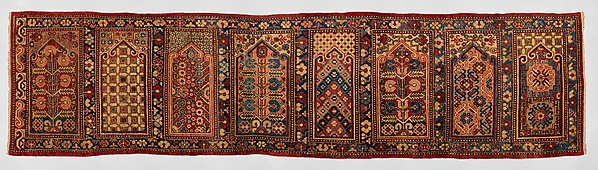
A mosque is a place of worship for Muslims, who often refer to it by its Arabic name, masjid. The word mosque in English refers to all types of buildings dedicated to Islamic worship, although there is a distinction in Arabic between the smaller, privately owned mosque and the larger, “collective” mosque. Although the primary purpose of the mosque is to serve as a place of prayer, it is also important to the Muslim community as a place to meet and study. Modern mosques have evolved greatly from the early designs of the 7th century, and contain a variety of architectural elements such as minarets.
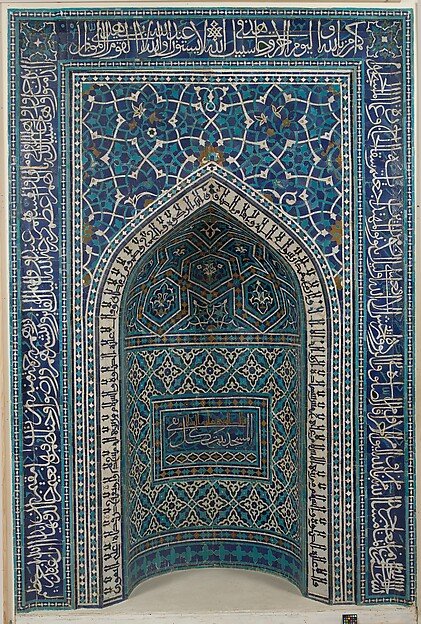
Mosques may serve as places of teaching, charity and community organization as well as prayer. People normally remove shoes before entering carpeted prayer areas. Architecture can include a minaret, a prayer niche and a pulpit, but a mosque need not have every familiar feature. Prayer can also take place in an appropriate clean space outside a mosque.
9. Giving, fasting and shared time
Wikipedia for Schools, Islam; ATD attribution (45). World Religions, Five Pillars of Islam. Source · CC BY-SA 3.0.
“Zakāt” (“alms”) is giving a fixed portion of accumulated wealth by those who can afford it to help the poor or needy and for those employed to collect Zakat; also, for bringing hearts together, freeing captives, for those in debt (or bonded labour) and for the (stranded) traveller. It is considered a religious obligation (as opposed to voluntary charity) that the well-off owe to the needy because their wealth is seen as a “trust from God’s bounty.”
A familiar zakat rate is 2.5% on certain forms of qualifying wealth held above a threshold, but rates and rules differ for categories such as agricultural produce. It is not a universal tax of 2.5% on every possession or every kind of income. Sadaqa is voluntary giving. A waqf is an endowment that can support a mosque, school, water supply, hospital or other charitable purpose. These practices connect religious responsibility to the use of property.
John Mack, in Tim McKenzie, ed.. World Religions, Islam. Source · CC BY-NC-SA 4.0.
The fourth pillar is sawm or fasting. Muslims fast during the month of Ramadan. Because the Muslim calendar is a lunar one, Ramadan does not coincide with the traditional Western calendar. The dates of Ramadan, therefore, vary from one year to the next. During Ramadan, Muslims fast from food, water, tobacco, and sexual relations during daylight hours.
The fast runs from dawn to sunset, not simply from sunrise. The Qur’anic image of the white thread becoming distinct from the black thread refers to the approach of dawn rather than a requirement that every person test actual strings. A pre-dawn meal, suhoor, and the sunset breaking of the fast, iftar, structure the day. Exemptions and alternative duties address illness, travel, pregnancy, nursing and other circumstances. Details vary by legal school and situation.
Ramadan also emphasizes Qur’an recitation, charity, prayer and self-restraint. Laylat al-Qadr, the Night of Power or Decree, commemorates revelation and is sought during the month’s final nights. The lunar calendar shifts Ramadan through the seasons of the solar year, so the experience of fasting differs by place and year. Eid al-Fitr marks the fast’s completion through communal prayer, giving, visits and celebration. Local foods and family customs give the festival many forms.
10. Hajj, Abraham and the sacred landscape
Ann Kordas, Ryan J. Lynch, Brooke Nelson and Julie Tatlock / OpenStax. World History, Volume 1, §11-1 The Rise and Message of Islam. Source · CC BY-NC-SA 4.0.
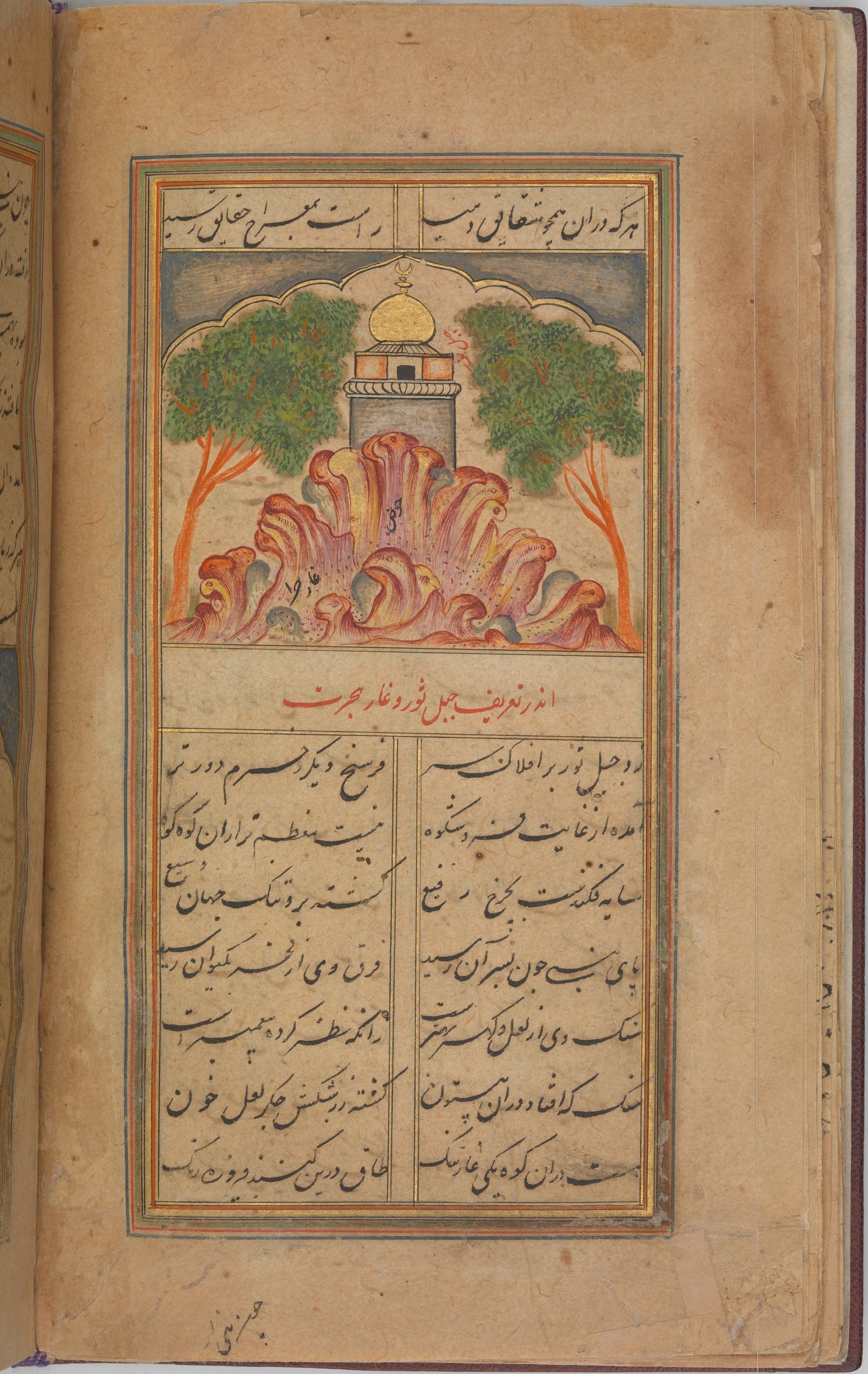
One of the core tenets or “Five Pillars” of Islam is participation in the pilgrimage to the holy city of Mecca. This event, when undertaken during the month of Dhu al-Hijja, is known as the hajj. Each year millions of Muslims travel to the holy city to take part in a process that has been going on for almost fourteen hundred years.
While Mecca was the home of the prophet Muhammad, for Muslims the pilgrimage is about much more. The rituals and events in which they participate are intended to reenact important events in the life of a different prophet, Abraham. The sacred mosque that is the focus of much of the pilgrimage is the holiest site of Islam, built to surround the Kaaba, the black-shrouded cube structure at the center that is believed to be the original home of monotheism. Some Muslims believe the Kaaba was constructed by Adam, the first man, and then reconstructed by Abraham.
Ann Kordas, Ryan J. Lynch, Brooke Nelson and Julie Tatlock / OpenStax. World History, Volume 1, §11-1 The Rise and Message of Islam. Source · CC BY-NC-SA 4.0.
Islamic law recognizes that the hajj is not a trip every Muslim will be able to take. Some may not be healthy enough, and Islamic charitable organizations around the world collect donations to support those who cannot otherwise afford it. Pilgrims may also travel to the holy mosque during other times of the year, which is not considered as having made the hajj but is instead called the umra, the “lesser pilgrimage.”
The Hajj takes place at appointed dates in Dhu al-Hijja. Umra, a lesser pilgrimage, can be made at other times and does not replace the Hajj obligation. The Kaaba is a sanctuary within the Sacred Mosque in Mecca, not itself the name of the entire mosque. Muslims direct worship toward it but do not worship the building or the Black Stone associated with it.
Pilgrims enter a state of ihram, with specified restrictions and clothing practices. Men commonly wear two unstitched cloths; women follow different clothing rules. The rites include circling the Kaaba, moving between Safa and Marwa, standing at Arafat, gathering at Muzdalifa and performing rites at Mina, including the symbolic stoning of the pillars. Movement between Safa and Marwa recalls Hagar’s search for water for Ishmael. These practices join prayer and bodily effort to the memory of Abraham’s household.
Eid al-Adha, the Feast of Sacrifice, coincides with the pilgrimage season and is celebrated by Muslims elsewhere as well. It recalls Abraham’s obedience to God; sacrifice and the distribution of meat connect remembrance with sharing. Modern arrangements can distribute meat well beyond the location of sacrifice. It would be inaccurate to say that every pilgrim must enter Mecca on foot or that Hajj is required of someone who lacks physical or financial capacity.
11. Ethics, food, family and the end of life
John Mack, in Tim McKenzie, ed.. World Religions, Islam. Source · CC BY-NC-SA 4.0.
The Five Pillars of Islam provide a foundational framework for a Muslim’s spiritual life, but they are not exhaustive.
Halal means permitted, and haram forbidden. These categories concern more than food, though dietary practice is often the most visible example. Muslims ordinarily avoid pork and intoxicating drink; requirements for meat and differences over particular foods involve legal interpretation. Honesty in business, care for relatives, restraint in speech, sexual responsibility and concern for vulnerable people likewise belong to religious conduct. Chapter 14 examines how shari‘a and jurisprudence organize these questions.
Family customs can mark a child’s birth through prayer, naming and charitable acts. Marriage is established through a contract, with a dower owed to the bride; wedding celebrations vary widely. No single regional custom represents all Muslim families. Death commonly brings washing and shrouding of the body, a funeral prayer and burial as promptly as circumstances allow. Muslim teaching generally favors burial over cremation. Mourning practices differ among communities, while prayer and care for the bereaved give communal form to belief in resurrection.
Daily prayer, scripture learning, giving and family duties connect individuals with local and wider communities. Their forms and degrees of observance vary. Chapter 14 turns to disagreements about authority and interpretation.
12. A short chronology
| Date | Event or traditional account |
|---|---|
| c. 570 CE | Birth of Muhammad in Mecca. |
| 610 | Traditional date of the first revelation. |
| c. 615 | Some early Muslims seek refuge in the Christian kingdom of Aksum. |
| 622 | Hijra to Medina; starting point of the Islamic calendar. |
| 624–628 | Battles with Meccan forces, followed by the treaty of Hudaybiyya. |
| 630 | Muhammad and his followers enter Mecca. |
| 632 | Muhammad dies in Medina. |
| Mid-seventh century | Traditional period of Qur’anic standardization under Uthman. |
13. Primary readings and questions
The primary reader provides complete short suras, longer accounts of prophecy and judgment, sustained passages about fasting and pilgrimage, and selected prophetic traditions. Read whole passages before turning a single sentence into a general statement about Islam.
- How do historical and Muslim theological accounts locate the beginnings of Islam differently?
- Why do Khadija, migration and the community in Medina matter to the story of Muhammad?
- What is lost when the Qur’an is treated simply as a book of laws or a biography?
- Compare Qur’an 112, 55 and 99. How do they teach through different forms of speech?
- What distinguishes Qur’an, sunna, hadith and tafsir?
- Choose two pillars and explain how each connects the individual to other people.
- What does the account of Mary in sura 19 share with Christian tradition, and where does it differ?
- How do the hadith selections connect prayer or fasting to behavior toward others?
- Why do the meanings of halal, zakat and Hajj require more than a one-line definition?
Primary readings
Read the primary texts for Chapter 13. This separate page contains the assigned passages, translation credits and reading questions.